
Called to
Artful Dialogue


Basics for Conversations
in the Complexity
of the World Now

A guidebook to the practice of Collective Presencing
by Ria Baeck in co-creation with practitioners

Collective Presencing Contributors to this book

Amanda Zamparo — diary excerpts, November 2021
https://amandazamparo.substack.com/

Cheryl Hsu — excerpts from blog, February 2022
https://cherylhsu.ca/post/2024-02-16-love-what-you-love/
https://cherylhsu.ca/

Eric Lichtman — essay, March 2022
https://erictlichtman.com/

Nick Shore — essay September 2022 + art from CP sessions 2020-2022
Nick Shore
Instagram @new.archetype

Kim Maynard — essay
https://substack.com/@dancingontheedge/posts

Kim Van der Hulst — essay

Dona Norfolk — field support
Linda Kochman — editing

Introduction

If you pick up this book, you probably are on a journey – longer or shorter, more or less profound – and realizing that ‘somehow’ ‘something’ ‘somewhere’ needs to change.

But what? And where?
How to do it better than so far?

Something in how we speak, listen and work together is no longer adequate for the world we are living in – our habitual conversational style needs an upgrade. Many of us feel this tension in teams, projects and communities – although urgently needed, collaboration in many project teams is disappointing – the issues we face are complex and urgent, yet our habitual way of conversing often leave us stuck, polarised or exhausted.

This book starts from a simple premise: the way we converse matters; our prevailing conversational habits are not sufficient for the many collective challenging questions we are facing.

Collective Presencing is a collective practice that focuses on how we meet one another in conversation – how we listen, how we sense and how we stay in relationship – also when complexity, difference and uncertainty are present. Rather than zooming in on ‘solving problems’, this practice attends to the quality of the relational field in which problems are held. It invites participants to bring their subtle, embodied senses into dialogue, so that conversations become places of shared orientation, creativity, coherence and co-creation.

This collective practice builds on individual practices – such as meditation, embodiment, contemplative inquiry or any spiritual practice – and places them explicitly in service of a collective inquiry process. Any personal practice is a much needed foundation, but is no longer enough; what is needed is a way of collective inquiry, in real time, with real stakes.

This book is a practical guide. It offers principles, patterns and examples in order to support any group that wants to engage in conversations that are more generative, relationally grounded and responsive to the complexity of the issues they face. It is not meant to be exhaustive, but usable – something you can take into your group, team or circle and begin practicing.

This book weaves together multiple voices and forms – essays, reflections, personal accounts – reflecting the nature of the practice itself: a constant interweaving of different voices with different stories. As with any practice, understanding emerges over time through engagement. The intention is a process of growing capacity, both for individuals and groups: to listen more deeply, to stay present together, and to navigate uncertainty with greater coherence and care.

Reading along, you can taste the different flavors added to the mix (even a tiny bit of AI structured this introduction, thanks to Dona). Slowly but surely you will get a picture of the whole weave in the end. As this collective practice is ‘a practice’ in the real sense of the word, you will notice how practitioners are changed – even transformed – through their ongoing engagement.

In this sense, the book is an invitation to continue your own unfolding in a group context, and offers guidelines of how to host and participate in conversations that are more artful, generative and alive. With this practice as the basis we aim for a working culture with deep respect for all things relational.

Shape of the book

The first part zooms in on what is happening in our world in this time and hence, what is it that we need to be able to change the trajectory of the world that seems to go downhill. We don’t spend a lot of words on this because we want to focus on what you need to start to have conversations in an enlivening way. (see Part 2) The different authors with their different styles each elaborate on different elements. I’m weaving it all together and will compact the essentials into some simple descriptions so that you can get started with enough confidence and also with an understanding of where you could fall off the tracks.

When you have been hosting or facilitating circles or meaningful conversations before, you could jump straight to Part 3 and 4. These will give you the finer details on how this type of dialogue is different from others. You will get more of its specific DNA explained.

Part 5 sketches out some elements and patterns that are crucial to make an actual network or community of practitioners work in a style and with methods that actually are in alignment with the core of the dialogue practice. Hence the self-organising nature of this venture and the learning points along the way.

To get started with applying Collective Presencing practice to your group you don’t necessarily need to read the last part. It describes more of the current developments in the network, detailing a bit more of the personal and interpersonal capacities needed to do this work well.
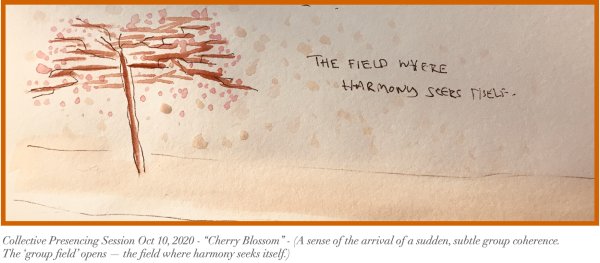
Part 1: Where are we? What do we need?

Part 1: Where are we? What do we need?

(Note: each of the six parts of the book begins with the offering of a single image. These images are from a collection of sketches created by Nick Shore either during or directly after Collective Presencing sessions taking place in the period from 2020-22. As such they are emergent ‘snapshots’, sourced directly from a sensing of the creative energies unfolding in that group field of that moment.)

It is clear for many of us that our usual ways of working and conversing are not up to the tasks and problems at hand. We know too well that there aren’t any simple solutions, and understand deeply that more rules, or more technologies, or more planning, or more business-as-usual don’t prepare us well for dealing with the hottest week on record, the fires, the floods, the inequality, the conflicts, … too many to name here. Each of you could add the specific problems that you encounter in your part and place in the world. The list is long, even endless. As humanity, we are stuck and there is a need to expand the solution space – wider and deeper – to be able to untie the many knots. Clearly, we are in need of something else: different and better ways of being with one another, with all of life around us. We hold the belief that if we can converse with each other, while fully embodying the many relationships we are part of – the connectedness and the constant interweaving – then we will be able to create another world.

We want to dive deeper into Life itself, into a deep embodied understanding of what it is to be fully alive, to be fully thriving together. If you look closely, you notice that most current conversations are not bringing the meaning or the clarity needed, but just offer more of the same. Hence we return to some basics: how we talk with one another, how we create new meaning together. Tending to the basics doesn’t mean it is all simple or simplistic. Basics refer here to a root layer that most of the time stays invisible to our normal, habitual ways of looking. Are we speaking from the assumption of being separate beings, or from an embodied sense that all things and all people are somehow related in a soup of complexity? This is the practice we will describe to you.

The beginning

I came to this collective practice, which is now called Collective Presencing, because I was intrigued by something that now and then happened in my early circle practice. Imagine a group of people, sitting in a circle, listening with great attention to one another, all engaged with a really difficult question. The kind of question that holds the complexity of what is going on; all realizing that a planned and even a complicated approach is not going to cut it. Sometimes it felt as if we all entered a different space, a deeper level of insights, somehow tangible, but still subtle – hard to describe.

I was intrigued by this magic in the middle: as if one was speaking from a different place than usual; as if we were all, somehow, contributing to a puzzle image that no one had seen before. Enough difference with our normal speech that we saw it as magic.

Within the context of me getting to know – and practicing deeply – several participatory methodologies I found myself returning to what we called the mother of all methods: the circle. Ancient as it is – the tribe meeting under the local tree, or a group of friends meeting around the campfire – it has been brought to our (Western) attention by a couple of people and networks: The Circle Way and The Way of Council. Old social technology translated for our times.

I went on a quest – with many, many people in many circles over many years – to understand the conditions to make this magic happen more easily. One element in this search was the term – and some of the practices – of Presencing, as brought to light by Otto Scharmer. Presencing is a new word invented by him; a compilation of Presence and Sensing. Being as present as you can in the moment, and sensing into the potential or even the future. Now that came very close to that wide-open attention, witnessing and listening that I had noticed in these specific moments. Important to me was to add the word Collective. Deep inside of me (hence the importance of that word sensing) I knew that we were dis-covering something really new, and that we had to practice this together. A generative dialogue practice that builds on the capacity of participants to be fully present or here – through any personal practice that they might have.

Why Collective Presencing?

“The systemic is not to be seen by one person.” – Daniel auf der Mauer

What becomes possible when we are all fully present in this moment – not distracted or caught by any pattern in thought or emotions – and can sense and think creatively while engaging with some wicked questions that try to deal with one of our many global questions? What really is possible then?

Not falling back in conceptual thinking: we should do such and such… not assuming the others will do what is needed: it would be good if… but all of us become first movers, even in the simple act of articulating some deep felt sense of what is going on or could be possible. Or taking up some responsibility with some others and making something out-of-the-box happen, something that never existed before?

Most people drawn to this practice are steeped in one or more religious / spiritual / embodied / psychological traditions, sometimes with more than 20 or 30 years of experience in yoga practice or Quaker meetings or Authentic Relating or… others just entering the worlds of embodiment, personal growth or spiritual practice. That’s maybe the most intriguing thing: we are all coming from very different streams of practice and we don’t have the need to name the ocean that we’re flowing toward. That kind of linearity doesn’t hold our attention. What is crucial though is that we witness, value and respect each contribution and we keep our senses wide open for what the weaving of it all reveals.

It’s pretty amazing that we can respect the integrity of each wisdom stream – be it Christian, Feldenkreis, Jewish, shamanic, Circling, druid, Integral, yoga, circle practice, improv … We notice the deeper, shared layer of connecting deeply, through the body practices, to the more imminent. The different streams don’t get in the way of coming to collective clarity and wisdom. It is actually that deeper quality (of being in an embodied practice) that draws most of us in. It seems to allow for more essential wisdom. A next iteration of collective wisdom that might be of good use in communities, teams, groups and organisations; to establish a conversational style that will bring wisdom and wholeness regardless of what topic we look deeper into.

We are not spelling out the doom and gloom that we notice is going on in this world, instead we are asking ourselves how can we be more like elders or stewards together – of all of life on this planet – and hold and refuel the needed wisdom? Where in our society can we come together to do this, not tied to any preconceived frame or theory? What are the pure essentials for a conversation to lead to these outcomes?

When we stay present together – to the rawness of life now – we can enter the fullness of a shared silence. Then we become a we that is available to life and living.
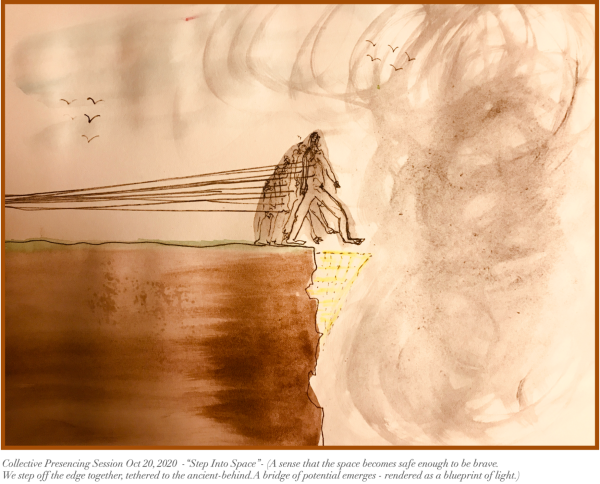
Part 2: Getting Started

Part 2: Getting Started

Personal Stories & Essays

This part will get you started. You will find a few diary entries, an essay and a description of some basic elements of the practice. Enough diversity to get a sense of the many aspects of life that are touched when you start to have such a simple intervention as changing the way you share and the way you listen to and with others.

First is a one page written by a Dutch man, you will notice how the practice invited him to be more authentic and how that spilled over into his personal life.

Blank Pages, by Kim Van der Hulst

Who am I here to write, contribute to a book? Me, with my fear of writing or expressing myself?

Having done attempts before and suffered miserably.

What is different now, what has changed? A lot of things have changed. One remarkable thing has been stumbling into The Stoa, first on YouTube and then on the website and from there this curious invitation to join a Collective Presencing session with people I didn’t know, with the only real ask to keep my camera on.

Getting over the initial fear of picking up a talking piece, slowly melting away the tension and inner expectation of needing to say something profound or meaningful, beyond the sense of it being alive for me.

Slowly allowing my perceived obligation to respond to what others were sharing to also be swallowed by the middle.

Already after the first session I felt drawn in. Here something different was happening and I liked it! Not knowing why, a big part of me was feeling confused. In the early sessions sometimes only getting a few words in, but mostly leaving more alive than after most regular conversations I had been in in the past.

A changing inquiry question… “… entering the dark forest…” started to shake things up even more. My body trembling of an energy that’s hard to pinpoint. As soon as I picked up the piece, gone! Clarity. Calm. Now what do I say?

I engaged in the Book club, in a Deep Dive, in weekly Open Sessions and in the Core Practitioners meetings. Now, almost a year later I’ve been co-hosting, tech-hosting and hosting Open Session, started experimenting and initiating sessions around specific themes, and joined Creative Presencing for Leaders.

Finding new ways of expression, new freedom in expression in many forms: spoken, in sounds, in movement, in drawings, in writing.

Deep connections with fellow travelers for the long haul, sometimes with hitchhikers for a single session. All welcome, all good.

Listening without the need or obligation to respond.

Speaking without the expectation of a response. And unexpectedly often feeling more heard and seen then if there would have been a response.

Relaxing and trusting the timing that an impulse to speak will come, being content if it doesn’t, even for a whole session. Slowly but surely showing more of myself, more personal, more spacious, louder, more spontaneous, more direct. More alive. Parts of me that were frozen and stuck slowly thawing in the warmth radiating out of the middle and the people gathering around it. Not in huge cathartic moments, but in a gentle flow of subtle transformations.

And throughout this year I am really feeling more globally connected. This time not by traveling to these places physically, but by hearing the stories and feeling my friends in these other places.

This ever-deepening appreciation for a good, rich and delicious inquiry question in the middle. Turning into a sommelier of expansive questions, getting drunk by the unexpected twists and turns that our shared inquiries take. Fresh insights, new ways of looking and connecting with the world and all its different dimensions.

All the while a part of me is still confused about the practice: what am I doing here? What are we doing here? Am I wasting my time? Then slowly seeing the practice sprout in my life. In conversation with my partner I catch myself actually listening, also there the expectation to respond starts to melt into the middle. My mind is wondering if my partner still thinks I care. The feedback that comes is that she feels heard more, given the space to actually express without being interrupted.

I trust the timing that if a response starts to form I can allow it to come out, more alive and spontaneous instead of pre-cooked and regurgitated.

From the group’s sessions, slowly the one-on-one meetings started to happen, sometimes on my invitation, sometimes by others. Deepening the connections with this wonderful group of human beings.


As Kim outlines here, becoming a practitioner of this type of dialogue, doesn’t go through deep cathartic moments but “in a gentle flow of subtle transformations”. I have seen amazing personal growth in many different individuals through attending weekly one and a half hour sessions (even online!): people speaking up who are generally very quiet, people quieting down who normally try to expose their knowledge, people taking initiative who normally wait for others … In general, participants in these dialogues come closer to their unique essence, taking up some initiator’s role, becoming more explicit about their own unique point of contribution.

Next for you to read is a first dairy entry by a young Brazilian lady. You will meet her a couple of times here, sharing about different elements. This is her opening sentence: “I am opening my diary for you to read, and this is actually how Collective Presencing always felt to me: opening myself to be read by others, while being held by something bigger than my own judgments, or other people’s judgments. … As I start writing a potential part in the book, I observe what is present in me. There is excitement, there is passion, and love for this practice. There is also insecurity. And many other things on my mind (a to-do list, memories of the dreams I had today, a decision to be made about where to live) and a nice feeling of being present with my own mind as I write this, with music that is helping me to enjoy the flow.”

In the practice we start every conversation – after a welcome and a framing – with a check-in round. The aim is to let others in the circle know what kind of energy, or inner weather, you arrive with. It is also a time and space to share whatever is on your mind, in your body or emotions that block you from being more or fully present. Listen to what Amanda wants to share:

Not needing to be pretty, not needing to be important, by Amanda Zamparo

If I were to do a check in now, I would choose to talk about the importance of Collective Presencing.

How did it become such an important part of my life? What is calling me here?

I still remember my first session in Collective Presencing. I was so worried about my image on the video. I was caught up in my nationality, and in past experiences of being me, and being with international people. I was so stuck in my self-image… Then, I actually had to turn my camera off and leave the circle to pick up a package downstairs. I was off for about 20 or 30 minutes. When I was back, I still felt crazy enough to share something in the check out. I even pasted a link in the chat: Feminine Wisdom and the power of weakness. I felt the resonance, I felt like I had found a treasure, a virtual oasis where my body could rest, I felt home, and I just needed to voice that I was there. I also said: “I liked the question!”

With some time – I would say around 9 months in – I learned to use ‘hide self view’ in Zoom; I learned to free myself from the need to evaluate myself as beautiful. In my culture, I have been trained to look a certain way, so that I could belong – that is the conditioning. It seems stupid and boring as I write. It seems bullshit.

Anyway, it is bullshit! The Collective Presencing spirit teaches me, every time: cut the bullshit! Anything that has a hint of performance is gently invited to be dissolved, so that what is true might have some space, even if it is a small and fragile space: when it’s true, the collective body will recognize it and make it shine.

We can see when someone is being a victim of their own self-image, and starts to perform in the circle; we can all feel it. What is most amazing to me is that we don’t need to point at it, we don’t need to change anything in our hosting, we just need to be present with whatever is present: it doesn’t matter if it is our resistance, our admiration or our indifference towards someone.

The more I was able to identify – and be present with – my feelings of resistance, admiration or indifference – the more I was also able to experience openness, inspiration and curiosity for anyone in the circle – including myself.


Amanda describes well how a very personal conditioning could be dropped through the practice, without ever talking about it in the circle. What made this possible is the basic stance of this practice: one of non-judgment, both for self and for others. We will later explain how this takes form in what we name as not speaking across the fire. (in Part 3)

Following is an essay, by another core practitioner, an older US citizen living in Paris, wherein most of the basic forms and principles of Collective Presencing are presented. We will highlight and explain the core elements after the essay.

Emerging Presence, essay by Eric Lichtman

Collective Presencing emerges in diverse ways within a circle. Many interests, curiosities, potentials and challenges are stimulated when engaged in a Collective Presencing (CP) practice. CP containers can be quite organic, similar to a fruit tree that in very fertile ground can grow quickly with the right conditions—light, air, sun, moisture, rich soil, etc. During a slowly-paced, well-organized (well-rooted), 90-minute circle session, different stems and branches with their intricate blossoms and nourishing fruits often emerge. This writing mostly highlights one feature of a CP-oriented circle, based on my observations as a practitioner for over two years: Emerging Presence.

The basic guidelines for creating our containers in Collective Presencing are fairly simple and accessible. This, in itself, allows for a remarkable range of participants’ interests, as each circle formation tends to grow its inner structure and resonance around (and within), including all those who participate. While we may refer to The Field, The Middle, the Rim of the circle, the actual circle of humans gathered—we as participants, in a natural way contribute many vital elements, which include the wider environment. All of We (and everything) becomes included in this circle—all are vital elements that combine and mix into an organic, fertile, tree-friendly co-creation!

When we host circles for Collective Presencing, we begin usually with a short introduction, then move to a check-in, followed by a framing from the host or co-hosts. After this, there’s a question, an Inquiry that is put in the middle of the circle, which can serve as an anchor or a focal point, a center-point (but it’s not necessary for this Inquiry to be directly engaged); the Dialogue follows with the question available for participants to see. The Inquiry (or Guiding Question) serves as an entry point to “The Field.” As we participate in our Circles, and explore sharing around The Middle, we listen, speak, sense, feel, reflect, express, contemplate, and “climb into” or feel into—leaning into and collaborating with a world full of adventure and the unknown; we enter into territory truly beyond any one individual, embarking in this journey, in which trusting together becomes better, more enriching for collective wisdom to emerge.

We are reminded by the dialogue hosts—to express ourselves, as much as possible—from The Middle and to The Middle. Does this sound confusing? It really isn’t once one has the opportunity to step into a CP container. As newcomers learn ways to participate in a CP circle, each person, in their own way, learns to sense into the circle’s resonance. As participants develop some familiarity with how it feels to come into Presence, the energies co-created by the participants tend to co-regulate, taking care of themselves—when given sufficient awareness (presencing) within the circle’s parameters. We generate a warm invitation: Participants—be willing to share, be willing to learn, uncover, and discover—lean into our process, attend carefully, and be fully present.

A note about coming into presence: In my early years in grade school when class attendance was taken, the teacher would call the names—James, Sylvie, Frank, Felipe, Susie, et al. Nearly everyone responds by saying “here” or “present” as the teacher checks their class roll. Simply by showing up, and occupying a seat in the class, the student claims to be “present”—yet, what does this really mean? They signal that they are “present” by their physical sense of being in the room, and that they’re occupying or filling a seat. But, in a CP session, participants do not merely “occupy” a seat in the circle. We are invited to show up fully—body, emotions, thoughts, environment, dreams, wishes, and more; we invite ourselves and one another to become activated—to feel life flowing through us, pulsating, merging fully within an ongoing adventure of presence.

What, then, are the main ingredients that go into our discovery of “ongoing presence” during a CP session? What’s primarily happening when we engage in Presencing? How does our awareness and aliveness influence our circle practice? Further, what happens to our Presencing as we become more Collective? A focus on Presencing generates tremendous, ongoing curiosity for me. It leads me to this writing. It motivates the following inquiry: what particular qualities contribute to vitality, depth, and discovery within an effective Collective Presencing session?

Attuning to energies that surface during a CP session encourages more overall dynamism and aliveness in the CP container. Expanding our individual tuning into what matters, from a felt sense and a personal urgency, is an important ingredient to showing up and being more fully present. Then this becomes part of our shared frequency; as material is shared collectively, it takes on energy and we become more energized. The “juicy material” of what matters goes to the center, and resides in The Middle; it also becomes vital to the weaving within the circle. Collectively the circle deepens our practice into what matters in ongoing and somewhat mysterious, non-linear ways, as our being present becomes, quite naturally, Collective Presencing.

This ongoing embodiment, both individually and collectively, reflects a growing group resonance. We also incorporate awareness of ways we use our voice and words to communicate. We communicate with our tones, we express using gestures—we communicate with hands, face, etc. At times, we may feel a need to “sing” or shout or murmur, or even silently to gesture what’s present so as not to feel constrained by conventional expression. This process of embodying our diverse communication adds detail and nuance to our map of presencing: who are we, both as individuals, and as a collective body? How do we—as emerging presences—feel called to share, to witness, to become authentic, together, as much as possible during our session? As our body-sensing of energies naturally becomes more transparent, we as a group become more coherent. Quite subtly, our focus and attention become activated, which gives shape to diverse and co-creative contributions. We commit to bringing all of ourselves into a CP circle—body sensations, emotions, thoughts, beliefs, tensions, delights, mysteries, etc. We continually open to the potential within the circle, and our individual and collectively expanding sensibilities. We often experience a refreshed and expanded vision of Time and Space; we become dancing partners together.

Basics in the practice of Collective Presencing

Eric’s writing touches on a lot of elements, and evokes some of the atmosphere and the qualities present in this kind of dialogue space. The conditions to make this happen are quite simple; we will start here with naming the basics.

As mentioned before, the practice of Collective Presencing builds on the ancient practice of sitting in circle. Instead of trying to write something original, I’m copying here a few paragraphs from the longer, original book, Collective Presencing: An Emerging Human Capacity (3.3 Basic Circle Practice):

As a way for people to come together, the circle has been around since the dawn of time. Many people thrive in a circle because it implicitly invites us to treat each other as equal human beings. Sitting in a circle invites an experience that is a world away from what happens when we meet around a square table, or in rows of chairs with someone standing in front. The latter arrangements tend to bring in more hierarchy, planning, debate and discussion (from the Latin root discutere, which means: to chop into pieces). In the Art of Hosting global network, we often introduce the circle as the mother of all social technologies.

Sitting in a circle to have a conversation (from the Latin root con-versare, meaning to turn to one another) invites (more) equal relations in the group; it is an invitation to be a ‘leader-full’ group. Practicing conversation in this way, over an extended period of time, allows one to engage deeply with a group of people. It also offers an excellent training ground for the varied aspects of becoming present on all the levels described so far. It offers deep learning by immersion.

Circle practice, with its simple agreements and guidelines, (more on these later) provides a safe space that invites trust, depth, intimacy and authenticity. When applied consistently and well, its guiding principles create a container of trust that strongly invites each participant to express their unique self and to welcome others in their authenticity in turn. As the shared experience evolves, this trust and safety grow, and participants begin to risk ever-deeper authenticity, firstly within the boundaries of the circle and later in many other arenas of life and work.

Circle practice connects us deeply with our shared humanity, while simultaneously revealing how unique each one of us is. The witnessing quality of the circle invites each person to express more of who they are. We each realise that there is deeper potential in ourselves and in others as well.

Circle practice is not to be confused with a community culture of superficial saccharin sweetness (“we all love each other so much”). What we are talking about here is a method that has a clear purpose and focuses on a shared inquiry. The purpose of the circle is not to feel happy, but rather to learn together. It is a shared collective inquiry – although one can certainly become happy as a side effect! In the basic form, the focus is on how to become present – increasingly so and in ever more settings and situations – so that an emergent collective wisdom becomes available. In deeper circle practice, the purpose is to extend the alignment in all directions and reach a space of shared creativity and generativity that adds more to life than what is already present.

Welcoming and framing

Every gathering, every meeting benefits from starting well – and I mean indeed every meeting, even in business contexts! Circle practice starts with a welcome and some context setting that brings the purpose of the meeting front and center. Often the welcome is spoken by the person hosting the gathering (more on the difference between hosting and facilitating below), but that’s not a fixed rule.

How we frame or contextualise a conversation is much more important than we generally realise. Each time we meet, it is good and helpful to be very explicit about the intention for the meeting, the methodology we will use and the overall purpose of the circle. It is not wise to assume that such framing is superfluous and that everyone knows what we are about! While circle practice is very simple, framing the conversation at the outset helps to set clear boundaries for the container being offered (“This is how we do it, and why.”) and ensure that we are all on the same page in this learning environment (“This is what the conversation is about, this is our intention and our guiding question.”)

Introducing circle practice

As far as participants are not all familiar with working in circle, it is important to introduce the basic elements. These elements are few and simple, but very impactful when taken to heart. First is to speak with intention. This means that when we speak we do not let our words meander aimlessly, but we choose what is relevant to the question or the shared topic. Second is to listen with attention or curiosity, giving our full attention to what is shared by others, trying to understand what they are conveying beyond the words spoken. This is empathic listening, where we are able to feel or recognise in ourselves what the others are expressing. The third and last practice is to care for the well being of the group, specifically being conscious of the impact of what we say and how we say it.

One element that really sets circle practice apart from our habitual speaking is the use of a talking piece. The person who holds the piece is the one who can speak and the one that others are listening to. There is no interruption whatsoever. The use of a talking piece slows down the conversation a lot, and that is indeed our intention. We slow down to listen well, both to what rises up in us as we speak, and also to listen and witness what is being expressed through the words, the intonations, the small gestures, the silence woven in between by others. If we are to access some deeper and subtle knowing then we need to leave behind the quick pace of our habitual exchanges. Online, this can easily be done through un-muting ourselves and speaking our intention when starting to share.

Simple structure of a dialogue session

A Collective Presencing session has a very simple format. After the Welcome and Framing and the introduction of circle practice, the actual session starts with a check-in round, and then the dialogue is introduced by offering the guiding question with its specific framing. Within the context of our 90-minute sessions we want to give each person enough air time in a session; and out of experience, we split the group up in two when there are 16 or more participants. The session is closed with some form of check-out; which is also the time that the different breakout groups come back together. Let’s dive a bit deeper in each of these elements.

Check-in round

A check-in round is in essence there to let others hear how you are entering the conversation. Maybe your child was sick during the night? Maybe the recent news has shaken you up? Maybe your housing situation is shifting drastically? On the other side of the spectrum: maybe you are in a really good spot with your relationship? Maybe you are very happy with how your gardening has provided you with lots of vegetables? When others know a tiny bit of this background they have a better context to understand the vibe you are bringing in.

In sharing these emotions, these worries, these facts into the middle of the circle we will notice that it brings us more here and now, and that what was blocking us from paying full attention has had its articulation and can more easily move to the background. So, the aim is not alone that others understand a bit where you are coming from, it is also a service to yourself of being able to become more present.

How the talking piece travels through the circle can take two forms. In person-to-person circles it is quite common to pass the talking piece around the circle. If it comes your way and you don’t feel ready to share, you can pass it on to your neighbor and later the piece will come back to you. When more people are accustomed to the practice the talking piece can be in the middle (either physically or metaphorically) and people pick it up as they feel called to share.

The dialogue

Then the real dialogue part can start. The hosts of the conversation will introduce the guiding question for which we gathered; most likely offering some framing around the question. (More on how to find and articulate these questions later)

When it is a deep inquiry, it might be that several sessions use the same question. Still, a framing from a slightly different angle will inspire the dialogue. We tend to think too many times that every participant gets what we are doing or where the question is pointing to; I have come to see that is not the case. Another way of bringing in the inquiry is like an appetizer to a good meal. Taking care of a good framing will be appreciated and will enhance the quality of the dialogue that follows. In this dialogue we keep using the talking piece from the middle, as it slows the conversation down so we are able to access intuitions, hunches, unformed ideas, subtle sensing etc. It is also mentioned by the host that silence is more than welcome. There can be silence between the sharing of two people, but equally so each one in the circle can ask for some silence; thus as long as they are holding the talking piece everyone shares this silence and re-centers if needed.

Checkout or closing the inquiry

When working in circle, it is important to close the conversation properly. We give an opportunity for everyone to say a final word or sentence (or sometimes silence), to share the meaning this particular conversation had for them. An inviting question can be offered to guide this round of sharing; and could be as simple as: What do you need to voice to close the circle well? I notice how many times, in regular meetings, we drop this practice of closing, mostly due to so-called time constraints. When we don’t give in to this pressure, it is very rewarding to learn how people are leaving the gathering and what they take away with them from the circle. Sometimes you are really surprised how their experience is so different from yours!

More rules, principles and prompts, which get you deeper from the basics into the practice of Collective Presencing, you find in the next part of the book. They are not to be seen as strict rules, but more as invitations for everyone involved, as we want to stretch people’s ability to be in this kind of conversation, knowing too well it feels quite strange in the beginning, and it is quite different from normal conversations.


Part 3: A Practitioner’s Guide – deeper and wider

Part 3: A Practitioner’s Guide – deeper and wider

Now that you have some clarity on the basics of Circle Practice, we move on to what happens when one connects deeper to this particular collective practice; because this collective element is really crucial and essential.

The primary purpose of the Collective Presencing practice is learning how to be both fully your true authentic self and at the same time fully in a group flow state. That’s not some easy state to get into. We envision that we can do that eventually with anything and everything we engage with in life — but we start at the essential level: by first practicing how to do it in conversation. We see conversation – and we name our practice as generative dialogue – as the ultimate training ground – because it’s so complex and hard; it’s so easy to fall out of our authentic self, to be triggered, to stop the creative flow, to lose the coherence…

Of course, any personal practice that builds some awareness is already a brilliant starting point. Indeed, we have noticed that all of our regular practitioners are familiar with some kind of personal practice, from Feldenkreis, to 12-step program, to meditation, to yoga, to Quaker, to Authentic Movement, to… ; as if there is an implicit understanding what practice can bring to one’s life. Our aim in this practice is to be collectively present and collectively sensing! That seems to be a whole other story.

We will distinguish below some elements that are at play in this collective journey, fully realizing that in real life, in the reality of an actual dialogue these elements are all interwoven. They are like different lenses we use to look at the full process. We make distinctions here for the aim of clarity, but they are more like threads woven together, and in the end it is the tissue that is important, not the individual threads.

Being present with one self

Here again is Amanda sharing some experiences of how she experiences being and becoming present in a dialogue.

Not exactly ‘doing nothing’, by Amanda Zamparo

Being present is different than doing nothing. While I am doing nothing with my family, for example, on a Sunday afternoon, this means we are actually watching a movie, talking about life, seeing the sunset, lying down on a hammock, petting the cats or something along these lines. There is no attachment to a desired outcome, there is no job to be done and there is the possibility to rest.

In doing nothing, there is a state of relaxation that is similar to what we experience in a Collective Presencing session. We don’t need to be vigilant any more; we can relax our nervous systems. And as we relax, there is the possibility for something else to emerge; something that has wanted to emerge. But it is different than doing nothing: we are together with an intention, an openness to the unknown… The intention is to be present with each other, with a shared inquiry (there is curiosity!), with the observation of our deepest impulses, feelings and sensations.

While I am listening to other people in the circle, I’m just relaxing, taking it in… Having goose bumps that come from my heart, and different parts of my body. Sometimes I feel a deep sense of love for the people in the room. Sometimes my mind starts traveling through time, listening to others speaking (sometimes not understanding every word, sometimes just listening to the voices as if it were music) and also listening to my own body, memories, feelings emerging. Suddenly, I am surprised by my own body: it wants to speak something! It has something to say. Maybe I know what it is, maybe I don’t. Suddenly, the relaxation becomes a rush of adrenaline to step up, take the talking peace and speak! What happens now is something that I can best describe as: everything that was stuck in my body suddenly finds a way out, in a way that makes me feel good about myself: relief and sometimes pleasure.


This experience of somehow feeling in your body that something wants to be spoken through you – even if your conditioned mind doesn’t agree or shies away from it – is typical of the kind of sharing that we invite into the circle. We do want a dialogue that includes all kinds of knowing, also subtle noticing, intuitions, crazy ideas etc. next to scientific facts and more conceptual ideas, and lived experiences. We invite both the yin and the yang side of our human knowing.

Now let me introduce you to Cheryl, a young woman living in Canada with Chinese ancestry. She mentions this experience of being spoken through and becoming more porous.

Finding my feet, by Cheryl Hsu

I attended Collective Presencing for the first time with no idea about what I was stepping into or why (I would later describe that I felt called or strangely attracted). I remember the group of about twenty people checking in, and then we were asked to speak to and through the middle. I will not be able to tell you about the content of what happened, or exactly what we spoke of — but I knew I was extremely nervous, and I knew I had to go back. Something about it felt like the exact medicine I needed to hold and metabolize the intensity that gripped my body.

I wrote about the first six weeks of my experience here, with out-of-character vulnerability and fawning enthusiasm that I would later attribute to someone falling in love. (I both smile and cringe when I re-read the puppy-love innocence of my first love letter, just like I will inevitably cringe at writing this second one here).

I’ve been attending Collective Presencing consistently ever since, first simply learning how to speak to the centre.

And the truth is, there is also something weird and spooky about embracing the sensation of being moved or spoken through. What was previously solid becomes more diaphanous and ghostly, separation between self and the other is more porous.

And when I am in Collective Presencing, I begin to notice that just as the “self” is fluid, the territory of what we know, or reality is always shifting, changing – it feels alive. Sometimes, I wonder if I’m being haunted, possessed by the unseen subtleties in the dark forest. Yet, as I stretch in my capacity to become more porous and receptive to the people and environment around me, I feel more – more intensity, more joy, more grief. And I also feel over-sensitive and irritated.


Deep listening to self

This form of dialogue is one big ask to listen deeper; deeper to one self, deeper to others and even deeper to the whole – of the group, and including the surroundings, world events etc. These two entries by these ladies speak to this deeper – subtler – listening to one’s self, to what is authentically you beneath the conditioning we are all familiar with. You could capture it in: being non-egoic, while being fully engaged.

In order for this to happen there are a couple of prompts that we give to participants at the beginning of each dialogue session. The first one is that we invite silence: we are not afraid of having seconds, or even minutes of silence during the dialogue. We can even use our turn to speak – as we pick up the talking piece or un-mute ourselves in an online session – to ask for silence, whatever the reason is that we would need or like that. As we move away from our conventional conversational style, silence is first of all good to slow us down, to get out of the habitual groove, to be comfortable with it and let some whispers or inklings come through.

The second prompt is also about breaking our habitual way of sharing. We invite people to hesitate a while before they want to finish their sharing. These seconds or minutes can be used to sense deeper in one’s self, in one’s body, if there is something more to share that comes from a deeper or subtler place within. It turns out that this way of sharing does increase people’s self-awareness as we try to dive a bit deeper than our normal ways of sharing.

Different people use different words to name this, but in essence it is about speaking from a place that is different from the thoughts and ideas that were already formed in your head before you entered the circle. You can name this as speaking from a felt sense, from source, from spirit, from mystery… whatever words you feel at ease with. This kind of subtle sensing brings in a knowing that complements your mental and conceptual intelligence. It will enhance your inner knowing of what next step to take in a project or what is going on under the surface.

We all have access to this subtle sensing, what some people call the liminal (more on this in the last section of Part 3). As Cheryl mentioned it can feel spooky that you are able to articulate words and sentences and draw up images that have never before crossed your (conditioned) mind. I surely felt very weird when I started doing Automated Writing – now many years ago – let alone to later speak to others what new ideas or insights had come up. While practicing in this way, we are getting used to it… and we start to understand the wisdom that it holds.

Finding your way in, being present with others

Interpersonal dynamics… we all know them too well! They come up all the time; and being together in a dialogue space doesn’t prevent it from happening. We feel angry, sad, fear of judgment, shame… any of the many emotional (trauma) responses… This practice helps you on a path of generative dialogue that does not get mired in convincing others or defending oneself. You could see it as a practice of mindfulness in relationship, or mindful dialogue; or better even to call it body-fullness.

Again, we dive further in Amanda’s dairy where she shares about not being able to share what was really present in her, fear had blocked her… (she got triggered, or her nervous system got activated)… and then, in the next story, she was able to listen and witness, even in a situation that could easily be a triggering one, as it happened in real life and not inside the circle practice.

The day when I was not able to share, by Amanda Zamparo

I already feel so naked with the things that I am writing… I am going to be even more naked, if that is possible: naked with my confusion, with my messiness, showing the real body with real “flaws”.

Today I was not able to share what was coming up for me, because I was too afraid of judgments about my story. …..

At that moment, when I realized I was too afraid of sharing what was most alive, I could have just returned the talking piece to the center. Instead, I shared a piece of the story that was less intimate, less real… I didn’t make it up, the story was real, but it wasn’t what was most alive in that moment… And what really wanted to come through me, I will never know!


I can be in a Collective Presencing session whenever I decide, by Amanda Zamparo

Recently, I was talking with someone very dear to me – a close friend, with whom I have a deep relationship. He went on sharing what he was feeling, and suddenly I was observing my own reactions to it. Some grief, confusion and discomfort. When he was done, I paused for one moment, closed my eyes and I was just there, with the middle, in the middle of us. I realized there was peace in that space, and no need to respond. I realized that I was not feeling called to share anything, and if we were in a CP session, I would just sit in silence: and that is what I did. I was in a CP session, and I can be in a CP session whenever I decide to!

Suddenly, there was nothing to take personally, and he was just sharing what he needed to share. There was no need to attend. I was complete; we were complete. The old Amanda would just try to understand more deeply, ask questions, and maybe be obsessed about what he was sharing – but all that stuff comes from my conditioning, the insecure and uptight personality patterns. From the middle, there was nothing to be said, nothing to be asked.


Not speaking across the fire, but speaking to the middle and witnessing

To prevent interpersonal dynamics from spinning out, our next prompt when inviting others into this practice is this one: Not speaking across the fire. This is a serious invitation that goes deeply against our habitual speaking patterns in meetings of any kind: we want to answer, we want to agree or disagree, we want to be understood etc. Very practically, this prompt means that we don’t speak our agreement or disagreement with what someone shared, we don’t address a person in this way… in short: we suspend our judgment. Instead of arguing about who has the truth, our intention in the dialogue is to let the different spoken threads be woven together, we close the gaps through listening to the different things shared.

Of course, emotional judgments don’t go away immediately because we want it, but our invitation is to share it – whatever we notice in ourselves, in thoughts, beliefs and emotions – to the middle, and let it be held by the whole circle. There is no need to name anyone or to address someone… let your emotional charge be held by the rim.

This is sometimes easier said than done. It takes practice to be able to hold the intensities of old dynamics, of old habitual patterns, without crossing the fire, without blaming anyone, without expecting them to confirm what we bring, without … The deeper invitation here is to see the patterns – in myself, and in others – as patterns; as parts or habits that are not yet integrated in the whole of myself. We are constantly invited not to take it personally in any way, but to put emotions and related judgments (ours and from others) in the middle. Holding one another as we stumble, as we are triggered. It is a growth path through connection. Not speaking across the fire doesn’t mean we can’t mention somebody’s name or that a certain story or idea could be especially valuable or meaningful to me.

Once I captured it in this way:

Back to presence.
Embodiment.
Grounding.
Alignment: inside and outside.
Sensing the big evolutionary pull of a new human capacity.
Are we in flow? Are we in motion?
Can we speak “as the middle”?
The circle, the rim can hold it all

When we can hold old patterns in this way, our human capacity is freed up to align with a bigger collective, a bigger group of humans and even beyond. We cultivate a deep, embodied presence; with clarity of mind and an openness of the heart.

The prompt of speaking to and from the middle has on the receiving end the power and practice of witnessing. This is not a mainstream conversation or debate where one side somehow wants to win about who is speaking the truth; not speaking across the fire means that we don’t engage in agreeing or not agreeing. We deeply listen to the others; we witness them in their sharing. We take it at face value that this is how they perceive or experience things. Witnessing others can feel like doing nothing, but it is an attentive, energetic space that we hold for one another and it has its ripple effects. In a way it is pretty simple and at the same time so powerful. That seems almost a contradiction for Western trained minds, but it is connecting us to the power of noticing a simple flower opening, or noticing how the sunset is coloring the horizon.

We look at the imagined campfire in the middle of our circle as actually an active, energetic space. Many use the word container these days. It is not visible in any way but is, as Cheryl wrote, woven together by our listening, our witnessing, our bodies, our attention. This energetic space that we hold together through our intentions, can absorb a lot, it can act as a parking lot for arguments and especially for interpersonal triggers. You can learn to speak your emotional charge into this center, while taking full responsibility for the fact that it is your charge, no matter where the trigger came from. You are not blaming anyone; you just need to share what is going on in you, it will help you to be back in your center and in your own grounding. The middle can hold a lot.

Speaking from the middle: not interpersonal, but intersubjective

We just mentioned speaking to the middle, and now we will dive a bit deeper into what we mean when we invite participants to speak from the middle. For sure, this could be seen as entering more of woo-territory here, but in cognitive science this is called participatory knowing (next to other types of knowing).

Collective Presencing is a dialogue and inquiry practice – that’s part of its essence – and within this overall frame it also invites to go beyond just sharing viewpoints and perspectives into the common pool. We invite the subtle signals people receive, the strange dreams they had, the images that come up… we invite to speak and to share these while our center of attention is not just in our selves, but also into the fullness of this specific group and the unique potential that it holds; as if we listen to and speak from the fabric of our shared intention. It can feel weird in the beginning, but we are fully aware that our normal kind of conversations are not going to bring us a way forward in these complex times. In this kind of sharing the personal experiences goes beyond just being personal, but they become contributions to the participatory knowing, to the knowing of the circle or the knowing as the group.

This feeling of weirdness when we share from a personal experience is a good example of an assumption that we hold unconsciously in our normal conversations. We mainly talk about what we can perceive with our physical senses, or make arguments about general ideas and look at the rest as unreal, or as holding no truth. There are lots of other assumptions underlying our Western way of talking like: it should be linear, with no deep emotions etc. On top of these general assumptions, each specific group or team is holding their (unconscious) unique ways of looking at each other and the world. Many times we need some outsiders to point us to these shadows in our group culture.

Back to sharing our subtle senses: we are looking for and practicing what some call the imaginal (not to be confused with the imaginary). Here is a nice description of what the imaginal is:

And so the imaginal is a stance and an art (and for me a discipline, since I’m wired up that way) which is not bound to a particular location or type of question, just as the artist is not bound to a particular medium or subject matter. Perhaps there is a place called the imaginal realm, where all imaginal works can be found–a great confluence of intersecting realities, creative works, and artists, like a massive art studio. If so it would be a truly stupendous, wild and magical, dangerous and haunting and brilliant place indeed.

https://katymorikawa.com/what-is-the-imaginal-and-how-does-it-differ-from-visionary-processes/

As we mentioned, besides the middle being able to be like a kind of parking lot for our emotional stirrings, we see the middle mainly as a generative space, where we tend to this imaginal realm, where we listen into the weaving of the different threads… We tend to and listen to the space in between us. It’s not just me, over here, and you over there. There is an element that is in-between, an element that is us. Of course, we don’t see it, but it is an energy that can be felt. There is some kind of field that we don’t pay much attention to in the Western world, but it is tangible and we can learn to take it more into account. Like the simple noticing of how the atmosphere is different in between the trees in an old forest, or in between houses and pavement in a city.

Thus, this practice is not an interpersonal practice – where we would dive deeper and deeper into my and your personal experience and how they interlink – but it is called an intersubjective practice. Its aim is not to improve personal lives, or become better at one-on-one communication, but about learning to attune to more-than-one-self, picking up signals and signs that are important for the inquiry that we are engaged in. It turns out – because all is related! – that indirectly it does have a positive outcome on individuals and how they relate with one another. So, this word intersubjectivity is an essential concept in this work and is related with coherence (as we might experience between the trees), group beingness, and deep interconnectedness. It captures in another way the idea of this liminal, in-between space.

Speaking from the middle: can I learn how to do it?, by Amanda Zamparo

If I attune myself with the middle, within the intersubjective space, can I speak from it?

Sometimes I don’t believe this is even possible, as I am so full of conditioning and confusion.

Sometimes, it happens. And I can never be sure if it really did happen, or if it is just another illusion… What I know for sure is that there is a release of energy, an openness and a feeling of interconnectedness when I am very attuned with the middle, either if I am just listening or if I am being spoken through. I don’t worry about how I am being perceived any longer. I don’t worry if I am speaking what I am supposed to speak, if it is something appropriate or not – and I actually don’t think about it too much. I trust that my words were enough, and my silence was enough.


As I mentioned, somehow we are moving into some kind of dangerous territory with this invitation to speak from the middle; at least that is what our scientific trained minds will say. Cheryl writes beautifully about this struggle, and how we integrate the mystery of life more than we realize.

What is truer than what is phenomenologically felt?, by Cheryl Hsu

The haunted one is also wiser than she admits. Amidst the fears of “woo”, something primordial and ever-present within her knows that there is more than meets the eye. There is something delicious in the mystery here. There is also something more true and more rigorous in her phenomenological experience, in the animist arts of showing up and noticing.

But then I realize that there are no obvious maps. There is a book, but it tells me: you’re going to have to navigate the territory through direct experience — through touch and felt sense, through scents and textures. Because what is more true than what is phenomenologically felt?

What does it feel like to be part of a pattern that is emerging?

I’ve relaxed that part of me that can’t tear her eyes away from the maps, like purpose, foresight and rigour, that clings with clenched fists to “proof”: Prove to me that it’s real! Show me that it’s true! Tell me that it will save the world!

It’s funny – you try to look for the perfect partner, lover, job with a list of check-list attributes that you want to see: “they must be this tall and this pretty and this smart”.

And when you encounter your Beloved, you can’t help but “fall” in love. The earth pulls you down to your knees. Your animal body recognizes what it loves.

“Reality” is so much more magical than anything you can imagine or make sense of. You are awed by the mystery of love.

And the checklist is blown away by the wind.


To close this Part 3, we offer you two writings, one by Nick Shore. He lives on the East Coast of the US, grew up in the UK and has a Pakistani background. He has a background in big business and he describes the feeling of urgency that many feel in our world today: it’s time for action! Then realizing that indeed, we need to change the basics – and how difficult that is. Enjoy his particular artistic style!

What on earth is Collective Presencing for?, by Nick Shore

Always this damn question – What is CP for?

WHAT is CP for?

What is CP FOR!?!

Well, I have finally answered it.

(At least for myself. At least for now.)

And my answer makes me happy. Because I can explain it to my Mum. Which is my acid test for bullshit.

OK – lemme break it down…

Two months ago, in an existential trigger, I quit Collective Presencing

“Ok, ok, OKAY, enough-already.” I screamed. “I have been practicing CP for two long years. Now it’s time to go, go, GO – go do something with it. Some-Thing. Any-Thing. Shake the tree. Make it rain. Move the ball down the field.”

Well, I figured … the whole goddamn world is on FIRE and melting. And it’s obviously, globally, five-to-midnight (and several other versions of the 2021 Apocalypse du Jour narrative). I CANNOT simply sit in yet another CP session, floating around in a We-space-astro-soup, getting high off good vibes. It’s high time to ACT!

I didn’t even want to save the world. Not even a little bit.

I would have been happy to use CP to figure out what new floral pattern wallpaper to buy for my granny. Anything – just as long as it was directed at REAL LIFE ACTION.

(And just to be fair to myself, there was a lot of it about back then. I was talking to many folks in different consciousness practice fields who were rallying behind the old Elvis adage “A little less conversation, a little more action”.)

And so I took my own advice. And I tried to use CP to enact something REAL.

And it didn’t work.

Not only did it not work – it failed. Kaleidoscopically.

I brought a field of seasoned intersubjective dialogue practitioners together with business leaders – armed with a thesis that We-space’s transcendent Other might have Source-wisdom to offer on business’s key strategic questions. Game A tapping into wisdom from Game B. I described it as Googling God.***

What could possibly go wrong?!

There are a bazillion reasons why it failed. At least seventy five percent of them are based on my own shortcomings. And I’m not blaming CP for the other twenty five percent.

It just turns out that this isn’t what CP is for.

(Or at least NOT YET.)

I opened-up my project’s Black Box – as if in Pandora’s fever dream – and examined the crash data.

As I sifted through the cracked-mirror koans of my own psyche, scattered all over the crash site, this thought came to me from The Middle:

What if asking what CP is for is like asking “What is CHESS for”?

So I asked myself – what IS chess for?

My shortlist of answers unfolded as follows:

  • It’s not “for” anything
  • It’s for itself – the purpose of chess is chess
  • It’s how medieval kings practiced battle strategy
  • It’s the universe’s way of enabling Gary Kasparov to sing the song of his soul

Here’s the thing that I actually got from playing chess: when I play a lot of chess, I get amazingly good at all kinds of other hard things. Like thinking several moves ahead, concentration, memory, strategy, holding complexity…

What if CP is game-like?

What if Ria spent the last 20 years figuring out the few, simple, elegant dialogue-game-rules? (I know we Moderns hate the word rules, but stay with me. I’m on a roll.)

And what if we are at a stage of development of the CP game where the rules are found, and fixed. Or fixed enough to move towards something like art or even mastery within those rules. What if all of us are actually fumbling and stumbling towards a far-distant state of CP-Gary-Kasparov-ness?

But … CP is not, in fact, chess.

The goal of chess is, for example, to WIN. And one thing we know for sure about CP is that there is no winner (except perhaps the shareholders of Zoom). CP, if it is at all game-like, is not a practice that orients around victory.

It orients around holding, flowing with, and being extraordinarily present to subtle movements, to delicate ephemeral patterns, and to the complex balance of natural forces.

Like surfing?

While chess players seek to dominate the board, surfers seek to balance gracefully atop giants, riding them all the way to the shore.

The giants we balance on in CP one might call the waves of paradox. Here are five of them (but I’m sure they are as infinite as the waves on the ocean):

  1. How to be ever more our authentic selves, and ever more surrendered to the group experience? (How do we experience ourselves as both wave and particle?)
  2. How to take back our projections and triggers, and still speak to The Middle from our deepest authentic Truth?
  3. How to bring in our whole life experience, and still come as an innocent, with the blank-canvas-presence of a beginner’s mind?
  4. How to acknowledge that the Tao that can be named is not the Tao, and yet still name the Tao into being?
  5. How to hold the CREATIVE TENSION OF POLAR OPPOSITES until The Field opens to a transcendent third, entirely new, freshly emergent possibility?

In CP we speak not ABOUT but rather FROM/AS what is really present here, now. We HOLD, versus collapsing into our old selves or polarizations or contractions. We hold the ever-imminent possibility of paradox. We stay with what’s presencing. Now. Now. And now.

(That’s all a little hard to explain to my mum. I’ll say it here as I might say it to her. “Imagine trying to play chess while riding a surfboard? Well it’s a bit like that… but the whole thing is a kinda group discussion about … well, around a creative question!”)

Like chess, like surfing, CP is, in one way at least, only for itself.

For the sheer bliss and blistering of doing something deceptively simple … which turns out to be stunningly subtle and complex. So much so that it requires almost superhuman (or at least evolutionary) capabilities to do it with anything remotely approaching mastery.

I can explain the basics of chess to a ten year old in a day. I can get up on a surf board with a couple of lessons from my brother-in-law. But to master these things … a lifetime. And more.

Staying whole and open and present and in-flow, and only with what’s here, and only speaking when spoken through, in a group dialogue is – it turns out – insanely difficult.

It’s certainly one of the hardest things I have ever tried to do (and I have tried to do some hard things). In certain ways it’s harder than riding on a big wave. Harder than winning at chess. Harder, I would offer, because it’s like doing both at the same time.

So why on earth bother with CP – why bother with a silly dialogical game that’s insanely hard?

Well, here’s my answer:

CP’s scope of action is strictly the group dialog itself … but its scope of impact can be universal.

By practicing Collective Presencing together, we are learning new ways to be with everything and everyone else we engage with … in the whole of the rest of our lives. You don’t bring your chess board or your surfboard into the boardroom… but you do show up as the living embodiment, a living transmission of whatever skills you have honed in those activities.

And this is my actual lived experience of CP.

By consistently engaging in this simple, elegant, difficult dialogical practice, something has happened to the consciousness that is me. Something within is ripened by it – and it’s an ineffable something that I now take with me, as me, into everything I touch.

I am more my essential, authentic self; more present; a better listener; more able to drop into creative flow states; more sensitive to images of the collective field and zeitgeist; more able to sense into what’s actually arising here, now, fresh … and I am less hijacked by my projections, my triggers, and my pre-conceived concepts.

And I am no Kasparov, that’s for damn sure. I’m more the old guy with the dad-bod high-fiving himself because he stayed on the board for six seconds … But I’m a little better at chess-surfing than I was 2 years ago … or 6 months ago … or even last week …

This particular node of consciousness in The Field (ie “me”) is evolving … and that’s my tiny contribution to the perpetual evolution of consciousness Itself. And my personal evolution is thanks in no small part to this catalytic practice called Collective Presencing.

*** a post script on “Googling God”. At time of writing (late 2021) we were blissfully unaware of the imminent Artificial Intelligence revolution which has come to pass in the ensuing years. I find it interesting that humanity’s evolving relationship to that particular technology has qualities indeed of seeking wisdom from some omniscient god-like intelligence (albeit an artificial one). This mirrors, it seems to me, a deep natural human instinctual desire to commune directly with Source-wisdom. Our choice of communing with an un-souled versus an en-souled Source seems a pressing matter in the emerging zeitgeist.

Changing the conversation is changing the culture

Our domain of action – as Nick described here very artistically – is first of all conversational, but we envisage its scope of impact to be universal; because deep inquiries and good conversations are the foundation of all change and innovation projects. It is through our language that we create our world. We might say that group conversation – the deep dialogue we see is needed – is the pinnacle of human evolutionary achievement, the Mount Everest of human consciousness developmental challenges, the cultural moon shot of the next decade… it is what the current peak of evolution is asking us to master next as a species… So we start with this basic capacity to support authentic self and generative flow (at the same time!) everywhere else… We are well aware that we still have to learn a lot. You can read in Part 5 about the hobbles that we stumbled over in our community, but through the shared practice there is a new foundation from which we can look into conflict, into change, into the unknown future.

The fascinating thing is that these kinds of dialogues, non-linear as they are, are inviting in an aspect of life that we mostly leave out of our daily conversations: the interconnectedness, the interweaving of patterns, the deep complexities… just as Cheryl describes here:

Mystery – Grace, by Cheryl Hsu

The other day, T. shared lyrics to the middle: “I want to be beautiful, so that I can serve eternity.”

And just like that, lightning strikes and everything holding my body together shatters into particles. Tears flood down my face. Everything that feels ugly in me is offered to the centre, and I am held in inextricable, luminous wholeness. My body shakes, and I cry softly. I am witnessed and held by the other two women in the field.

In the aftermath of these experiences that can only be described as numinous, I feel at peace and full of wonder, like I’ve been touched by grace. It is not unlike the experience of architect Christopher Alexander after he climbs up the stairs of the Buddhist temple and is visited by a dragonfly.

“As I sat there, a blue dragonfly came and landed on the step beside me. It stayed. And as it stayed I was filled with the most extraordinary sensation. I was suddenly certain that the people who had built that place had done all this deliberately. I felt certain – no matter how peculiar or unlikely it sounds today, as I am telling it again – that they had made that place, knowing that the blue dragonfly would come and sit by me. However it sounds now, at the time when it happened, while I sat down on that stair, there was no doubt in my mind at all that there was a level of skill in the people who had made this place that I had never experienced before. I remember shivering as I became aware of my own ignorance. I felt the existence of a level of skill and knowledge beyond anything I had ever come across before.”

How did this come to happen? What are the conditions, the design patterns, the architectural affordances that came together to form this timeless moment, as though it was by deliberate design?

What Collective Presencing invites are these moments of meeting your dragonfly, of making contact with the beloved. I’m always surprised in every session. These aren’t just ideas, they are living and embodied. My animal body yearns to connect more, to make more contact, to create more life. I don’t know what will happen. I tremble. My heart beats. I speak, and what comes through is more mysterious, more whole, than I can imagine.

I want to participate with the mystery that moves my trembling body.

I hope that you do not read this as the lovesick ramblings of a person drunk on the early infatuations of love. Because what is here is very sober, very steady, very fierce.

You see, describing Collective Presencing is challenging, like describing love. I can’t pick it up and show it to you, break it down into atoms and point it out under a microscope. I tell you that it matters deeply. You’ll know it when you feel it. At least, that’s what the poets and songwriters tell you anyway. Don’t look for it, because it will find you. And suddenly, you’ll feel it through the interdimensional passage of time, space and memory – the remembrance of your mother’s kiss on your forehead, fluttering like the shimmering wings of a dragonfly.


We will now dive deeper into what it takes, in personal and interpersonal capacities and even spiritual capacities to actually host dialogues well. On the surface it is really super simple, as you could read so far; but there is a lot going on that isn’t visible to the naked eye. Indeed, as Cheryl’s entry here speaks about Mystery and Grace – words that were not part of my daily vocabulary when I started this journey – that is more and more where we will end up. Not in any woo-woo or fluffy way, but in the sense of wholeness and interrelatedness. The stuff that living complexity is actually made of: everything-is-connected-to-everything.

Part 4: Building capacity to host dialogues

Part 4: Building capacity to host dialogues

From participant to host

By reading the two previous parts you get a fair clear picture of what is needed to start hosting dialogues. You got some idea of what to do. In this part we zoom in a bit more on the journey of learning and on the how. Of course in your real life, when you start to try this out, the what and the how cannot be teased apart. You will focus more on the what and have forgotten that the how of this doing was also important; or the other way round. It’s all experiment and learning; all good!

From participant to co-host

Personally, I had a great example and experience of how to keep the DNA and the quality of a practice in a self-organising network by being a long time practitioner and steward/trainer in the global Art of Hosting network. For a long time I looked to find out what the essence of this trick was, because we didn’t have a central authority, no legal structure, no accreditation, nothing of all that. Still, over many years, many countries, many participants and many training workshops the essence and quality of the practice was – and is – kept alive. My final answer is: it’s by putting the ones who want to start practicing immediately in the role of hosting others into it; with other newbies; in co-creation. Just start trying. Of course with some mentoring where needed, but by giving a lot of trust to the people and trusting the (learning) process. So, this concept and this role of becoming a co-host is a crucial step in the learning journey. It is the path of the journeyman in the traditions of craft building. You were allowed and expected to do certain tasks, while fully knowing that you hadn’t reached a level of mastery. We don’t approve of the bad hierarchical practices that might have been part of these traditions, but there is truth in the saying that practice makes perfect – actually I like the Dutch expression better, which translates as practice gives birth to art.

That’s what I did immediately – when asked at the beginning of the pandemic to host practice sessions online (Phew, would that work??) – asking others to co-host with me, and sense together what question we would offer for the dialogue sessions (even if I didn’t know them!). That’s a practice of capacity building that we still use. (more on constant capacity building later in Part 5) Every dialogue session has a main host and a co-host (and a technical host for online sessions). Co-hosts typically introduce the guiding question when we have breakout rooms. Through this task in a smaller group they can grow their confidence to hold and host. In the frame of a rather informal capacity building we add to the open sessions a 30-minute debrief where anyone interested can join. All kinds of questions and comments about the practice itself are welcomed (and rather not about the content of the inquiry). This has become a major learning time for upcoming hosts. They can bring in as many questions or observations as they have; and more seasoned practitioners share from their own, sometimes divergent, experiences, all adding up to a rich learning environment.

From co-host to main host: Hosting a first dialogue

Typically we see people participating in several dialogue sessions, after a while asking questions about the experience of hosting and what is happening in the circle of practitioners, to then step up to host dialogue sessions themselves; eventually it leads them to more participating in Life itself.

Framing & entrainment

One of the things to become aware of when practicing to become a good host for this kind of dialogue is the realization that the presence, the awareness, the embodiment that you hold when you are inviting people to join is of equal importance – or maybe more important – than the content of your welcoming and framing of the conversation. We mentioned before (in Basics…) that framing a meeting, or any kind of deeper inquiry, is of great importance: it puts everyone at the same starting space, it reminds everyone why we are gathered.

In the case of framing this specific dialogue practice it is really important that the content that you speak is carried by your presence in that moment. Your embodiment, your depth of presence will be experienced by the participants – in the beginning mostly unconsciously – but it will invite them in to speak from a similar depth. This dynamic has been named in the literature as entrainment.

Difference between facilitation and hosting

The big learning for most people is that what we call hosting a conversation is different from facilitating one. It comes out of the body of work that is called Art of Hosting. One of the elders would present us with the question: when you invite your family or some friends over for dinner to your house, are you hosting them, or facilitating them?

There is for sure care involved in both hosting and in facilitation, equally preparation and planning, and still the relation between you as the host and the group is different than when you are the facilitator. The main difference is that as a facilitator you stick with the goals and purpose as agreed with the group or the client; as a host your main job is to be present and to attend to what is really emerging – meaning in some cases to change the design in support of this. As hosts, we don’t attend to what is called group dynamics – as we leave that to the middle, and to the rim to hold it – but rather to what we might call the group field – the inner and subtle awareness of the complexity that is any group, and its potential.

Instead of being focused on what others in the circle say and do (or not), attention is fully grounded in the ongoing collective inquiry and the shared field of awareness. Hosting merely supports the conditions for emergence. We learn to see and to be constantly aware of the inter-affecting, to use a word from Eugene Gendlin, and the interrelated moving.

In essence, hosting these kinds of dialogues isn’t much different from participating, as we too join the dialogue. The difference is in the welcome and framing of both the session and the dialogue question, and in keeping an eye on the time.

Collective Presencing as collective inquiry

Finding the guiding question

It can’t be stressed enough that Collective Presencing is in essence an inquiry process. There is always a guiding question to which we really don’t have an answer that the dialogue seeks to dive into. Although, right now as I write this, most sessions happen online as a pure practice space with participants from different corners of the world. In that sense we are hardly a project team. As we move – slowly but surely – into real world projects with this practice, the finding, the un-earthing, and the dis-covery of the real question is a deep and essential part of the practice.

Even for the online sessions, we do take great care and spend quite some time and detail on articulating the guiding question for the inquiry; to find a question that brings us to the edge of our current understanding. At the same time we see some people using it on the ground, in face-to-face meetings. The ultimate purpose of this practice is of course application in real life situations, with wicked, complex, entangled problems.

In our mainstream Western world, when encountered with problems we tend to look for solutions. It is mostly unconscious – to our conditioned minds – how different assumptions slip into how we phrase a problem. Most of the time we don’t realize how many assumptions are already baked into how we phrase our questions and thus point us to a specific and limited range of solutions. In a complex, dynamic world there aren’t any simple solutions possible, because of its living, ever-changing nature. Thus, a real generative question is one that scatters some of our unconsciously held assumptions of how people or the world works, and is in some ways pointing to a deeper level of potential and meaning.

We start in this question finding session by sharing what really is at the edge of our current understanding, what we are really, really curious of. At first the collection of shares might look quite chaotic, but surely – by listening to the soil beneath them – some kind of theme arises. Most likely there are words, spoken by different people, that have some resonance for most of the group; these will eventually end up in the formulated question. The question will be challenging for most of the participants, as it will invite them to widen and deepen their perspectives and eventually see more of the potential and possibilities.

The aim of these question-finding sessions is to become aware of our assumptions and try to articulate a question that goes beyond them. Engaging with the question, through the ongoing dialogue, will even reveal more assumptions. What this engagement leads us to is that we become more and more aware of the potential, the possibilities that are actually there, but beyond our current paradigm that limits us to see them.

It’s not an easy, quick work to do, as part of it is sensing into the deeper and wider potential that is somehow on the horizon, – although not totally visible or tangible – and still trying to pour it into words and language. Through these careful crafted questions we invite what John Vervaeke defines as ‘imaginally augmented perception and cognition’. Later in this part we write a bit more about the imaginal… in pointing to that direction we implicitly give people the message that this part of our realities is welcomed; and even needed to get a glimpse of what could be possible.

The fact that this type of dialogue is centered on a guiding question makes it different from classic Bohmian dialogue. Although the implicit assumption there is that we are inquiring into how our minds work in relation to the world at large and indeed, trying to see what kind of assumptions we are holding in this regard.

Some examples of inquiries

Below you find the guiding questions we traveled with at the beginning of our online sessions.

From April to Dec. 2020: In this pause, as we – together – sense into our potential, what is it that we glimpse?

From Jan to April 2021: As we travel through the dark forest together, how do we cultivate / uncover / live our collective night vision and our wild intelligence?

after Easter 2021: What possibilities unfold when we open into the magical trembling that dances between fear and awe? Who are we then becoming?

Summer 2021: How am I uniquely called to participate in/as the collective body/organism? How can we now express that what to this point has felt inexpressible?

January 2022: If we collectively attune our attention to what we and the planet—and what we as the planet—need together, what radical new worlds do we co-create?

Intimacy and intensity

To introduce these deep core elements of the work, let’s turn to another writing by Cheryl…

The container can hold more, by Cheryl Hsu

Thich Nhat Hanh writes about interbeing, the Buddhists have long talked about co-dependent arising. First Nations people around the world live by indigenous cosmologies of sacred interconnection. Quantum scientists like David Bohm describe the interconnected Whole. The truth is simple: we are all connected. But what does it mean to actually feel this living sensation?

David B said in the session last week: there are energies in the earth that are too much for one body to hold.

When he says this, I remember the morning I learned about the mass graves of over 750 Indigenous children that were buried in Canada. When I read an article about it, it was too much. I felt numb and disconnected. Before going into Collective Presencing that day, I could feel the pressure and tension heavy in my body. But upon arrival, something in my body felt held by the container, this collective body made up of our attention and bodies. And when it felt held, I collapsed into tears and sobbing, touching into the indescribable pain and despair that I had forced down below, now rising, swelling and passing through my body like massive tidal waves. It was painful and difficult, and it was healing and releasing. I needed to connect with the grief and suffering of these children, to sense into the intergenerational pain of the adults who put them underground, to touch the cold cement of the unfeeling institutions, systems and cultures that alienate us from each other and the planet.

The weight of Collective Trauma is too much for one body to hold. Yet I wasn’t alone. I don’t cry often, I’ve spent my entire life trying to hold it together. But sometimes, you’re holding it together behind a tough exterior, and then you see the trusted, loving face of your partner or your mother, and something cracks through. Your animal body knows, and it gloriously falls apart. You allow yourself to be held in the safe arms of your beloved.

The landscape of my body is unique to me, lined and storied with my ancestral traumas and living experiences. And yet deeper currents run beneath… a hidden order entangling us at greater depths…

The more I practice and stretch my body to hold these waves of intensity, the more the thick walls of separation begin to dissolve. Skin becomes translucent and porous. As I leak more into the world, the world trickles and spills into me, flowing through the rivers and tributaries of the body. The territory of Self becomes a dynamic meeting place of fluid circulation and reciprocity. Paradoxically, the more tender I become, the more resilient. I cry more. I laugh more. I trust more. I care more. I love more. And when I do so, I feel like I’m doing so through and for something larger than just me.

Holding of and by all participants

Through Cheryl’s intimate sharing we can read that through the holding of all the participants of the group, and through the holding by all the participants, the energetic container, the circle, that we form and are, individuals are able to stretch in what they can hold and express in their own body. It is through the experience of this kind of dynamic that we become more and more aware of the interweaving, the reciprocal dynamic of the I and the We, the I and the land, the I and the World.

Through the sharing to the middle we hear different perspectives, and some might be against our personal opinion, or we hear things shared that trigger an old emotional field in ourselves. The intention to listen to the middle – which translates as leaving certain sharings / opinions / perspectives just there, in the middle and not taking them on, not taking them personally – is asking us to develop a capacity to hold more intensity in our body than usual. We don’t re-act as in any typical mainstream debate, but learn to come back to our own grounding and center and hold this emotional intensity, both in our own nervous system and in the co-regulation with one another. This type of dialogue can do that – it is a practice where we exercise these muscles needed so much in our time.

I have seen, again and again, that deep and vulnerable sharing of specific pain and grief by some of the participants, is a door into a deeper intimacy for the whole circle. My view on intimacy has changed from a more psychological one – I have a capacity to be intimate with you – to see intimacy as the awareness of a field where everything is connected with everything. It’s more a movement into the spiritual, with the awareness that no matter what is going on in myself, in the group, in the wider environment we can learn to dip into this intimacy. This field of possibility, of interconnectedness is always there. Bonnitta Roy says: Root into the intimacy, and reach for the imaginal. It seems that the capacity to hold deep intensity allows for notes of grace to come in.

Collective Trauma

It is good to realize that Cheryl’s tears were about a collective trauma, way beyond her personal, individual life. Most of us who are willing to change the world for the better will encounter their version of collective pain; the list is endless no matter where you actually start your journey: be it climate change and how that links with racism, be it a women’s group and how access to business capital is still difficult, be it a men’s group and how boarding schools made children dissociate from their emotions, be it a church group and how abuse was silenced … These are all very big emotional wounds that go beyond one specific person, or one specific life.

Because we are part of a shared humanity we can feel this pain in our own personal bodies. We do need one another in the holding of it, and realizing: we are broken and whole at the same time – all of us. There is no leader / parent figure who is holding the wholeness, and we are the broken ones. We are broken – which brings sadness and grief and anger – and as humans together we can bounce back, we can learn to be OK with that level of intensity. We can be with all that humans do and have done, and we can still be OK. More even, training in these dialogues to hold the stories of individual and collective pain within the circle strengthens our nervous systems, step-by-step. Another participant articulated this capacity to look at collective trauma as Together, we could stand to look. Or connecting into / building a collective nervous system.

Strong emotions, collective pain are all stretching our capacity to hold intensity but there is also a stretching happening on the level of mental capacity, our knowing (of course, also related with emotions, because we cannot really separate them). When we engage with some of these deep inquiries, we soon discover that they don’t have simple or easy answers; at least no answer just yet. Holding that we don’t know yet where we are going (combined with the feeling of urgency!) feels very uncomfortable for most of us and we would like that feeling to go away as soon as possible, at least before the end of the meeting! Thus we tend to jump to conclusions or solutions, nonetheless, not taking into account the uneasiness we feel on some deeper levels, realizing we didn’t really think – and sense – it through.

This not-knowing-yet – because the answer doesn’t exist in some area of expertise, we truly haven’t been on this edge before – could be named as the art of discomfort. In the circles dealing with racism, this capacity to be uncomfortable together has been named as a crucial growing point for all involved. In the Art of Hosting models this phase in the collective learning is named as the groan zone. When many participate in a conversation, engage with an inquiry, many viewpoints and possible solutions come up: your mind is kind of overwhelmed because there seems to be no clarity arising. That’s where holding the intensity – not letting it collapse into emotions or simple thoughts – is needed. The new capacity here is to stay in this not-knowing-yet until an original spark comes up. Many times it feels as if a flip happens: from staring blind on the problem to suddenly seeing that the opportunity is exactly hidden within the problem itself! When you have experienced this a couple of times, this intense phase of not-knowing-yet becomes exhilarating, because you know something cool might happen. Every problem is pointing us to a potential, where creative responses come from a source that I cannot name as mine, but I can plunge into it and bring some inspiration or insights back to the 3D world we live in, the inquiry that is going on now.

This flip, for lack of a better word, is very much linked with the concept of emergence. We will dive deeper into this later in Part 5.

All these capacities we have tried to untangle here help us to let our identities being less fixed, less held in the typical boxes, and become more fluid with what is happening around us.

Hosting Collective Presencing dialogues is a collective practice

The Collective Presencing practice is something we do together; and hosting these dialogues we also do together.

Ability to ask for help

Sooner or later there will come a time when you, as the main host of the dialogue session, feel overwhelmed or suddenly you lose the thread… instead of getting panicky and/or trying to hide it, that is the moment to recall that you have a co-host with you – and even several practitioners – and you can truly relax instead. On top of it, you can name and speak what is happening to you in the moment (like in your framing or in the check-in) and just reach out to your team members, or even ask some seasoned practitioners if you forgot anything or if they can add to your framing. In that way we model, as a small team, what we actually mean by being a collective.

This opens up our rigidity around the notion that the leader, the trainer, the facilitator knows it all. The hosts are just human beings like all of us, and they are not always aligned and fully present – although they will prepare to be able to speak and invite from that place of course, but life happens, right? We want to break the projection related to hierarchy, which exists as much in the hosts as in the participants (maybe even more?). In the end it is not the position (being the one who frames the dialogue) so much that brings authority, but more the lived and embodied awareness of how you invite others to join you in the dialogue.

Amanda speaks below of how vulnerability and trust mutually enhance one another – linking here with what we wrote in the previous point about intimacy and intensity – and challenges us with a counter intuitive question that we can also apply to our role as dialogue host:

Vulnerability feeds trust, by Amanda Zamparo

It seems that sharing what is painful for us (if we are doing it in a genuine way) makes others trust us. It seems that vulnerability feeds trust, and trust feeds vulnerability. So the more we open up, the more we can build trust in any community.

So how can we remind ourselves of this more frequently so that every time we find mistrust in any group, we open ourselves more, we become softer, more vulnerable?


Never host alone

Never host alone is a good catch phrase to remind ourselves that time is over to be the hero, the one who can hold it all, can do it all. Many of us, trainers, therapists, facilitators, teachers, … can indeed hold a lot, and… we are all limited, human beings. It turns out that it is sometimes very difficult for people who have chosen these professions to actually feel that others can hold them, be it their co-hosts or be it the circle of participants. So, never host alone so you do have a back-up support when needed, and you can train yourself to drop the responsibility-for-all-and-everything. For sure, it is not healthy and leads to a lot of the burn-outs we see these days.

Below, Cheryl writes that it took her more than a year of practice to actually embody that trust that she is held; and how it leads to a collective capacity previously unknown to us.

Not alone in the field, by Cheryl Hsu

After 15 months of this dedicated practice, I know I am not alone in the field. We always co-host together, hold each other as a collective body of practitioners. We tune into E. with his dancing light, into N. for creative daring, T. and her senseful embodiment, D. for warm steadiness, R. with firm and loving wisdom, B. for wild imagination, K. for fiery passion, H. with fierce discernment, J. as innocent sage… and there are countless others unnamed, each with their unique frequencies and beautiful soul gifts that are generously, openly shared with the field. Our souls swirl together into the centre like a colourful kaleidoscope, creating this mandala spiraling towards a collective capacity and strength beyond our current imagination.


You need a field to hold a field

This is another important catch phrase to remember in this dialogue practice. How could you ever invite participants to be, form or experience the field of collective wisdom when you are speaking from a lonely position? I truly think that is not possible. Like Cheryl mentioned, this collective practice leads to a collective capacity and strength beyond our current imagination. But only, or with more chance, when the hosting team members form this little field together, that holds the wider field of potential of this whole group. The experience of being a field needs to be embodied by all in the hosting team. You invite from your lived experience, and participants in the dialogue will notice how there is no competition and no hard separation between all of you on the team.

The power of collective attention

Justin Frank, another of our core practitioners, wrote as a contribution to this book an interesting piece on the power of our collective attention; but it is too long to paste in here. Instead we invite you to read the following questions and give yourself some time to let them sink in. We just want to open your thinking about what collective attention actually is, and what it possibly could do.

What is it that this collective attention can do, when freed of individual ego-patterns?

What is the creative power of collectively attending to something, be it some trees, or animals, or man-made stuff? Do we notice they become more alive?

Can we cultivate our sensitivity and our receptivity so we notice the tsunami coming, as many animals do?

Can we grok the ongoing loop of us, collectively attending to something, which changes it and then be changed by it?

Strange things: the field of potential and emergence

The field of potential

One of the big differences between facilitation and hosting is that when in a hosting team we also tend to the field. We mentioned before the intersubjective field, that what is between all of us sitting in this group. It is difficult to explain what it exactly is, as it is something we perceive on an energetic level. Next to what is between us – as human beings in this circle – there is also the field of potential that becomes accessible with this group around this specific question. Again, we don’t see this potential with our eyes, or hear it with our ears, but there is indeed something subtle we can (learn to) perceive.

The best metaphor to point to this field of potential is thinking how parents hold the potential of a young child. They don’t know what kind of gifts their children hold: will they be good at sports? Or rather good in math? Or have a gift for drawing? Or singing? Or taking care of children? The parents hold open a wide space in which the child can explore many different pathways, and over the years the potential of this specific child becomes more visible and tangible. This is what good hosts also do: holding the energetic space wide open so that the potential of the group – with ultimately its brilliant, new insights and capacities – can come forward. We all have the immense capacity to be open, to be a channel through which the new can come, to even become a new process together. It’s a skill to hold this kind of space when the group is in a phase of not-knowing-yet, or when a conflict arises, still this is a new social capacity that will eventually give rise to collective creativity.

We mentioned before that how you frame a dialogue session, from what level of awareness you are inviting the other participants in, is of crucial importance. So, when you prepare to host a Collective Presencing dialogue one of things to keep in your mind’s eye is the diversity of the group of participants. Typically you don’t know what they are going to share and you might be surprised; but somehow you relate with the whole of the group and with its potential; a potential that hasn’t seen the light of day yet; but still that is what we are steering towards. As we try to set the conditions for emergence – some creative, new approach appearing – you can look at this type of dialogue as some serious play, or even see it as a new form of ritual.

Please read this blog entry by Cheryl who pictures this in a much more poetic language.

The Collective Field, by Cheryl Hsu

What is this field that we discover and create as we hold space of Collective Presencing through the vibrational frequencies of a video call? Let’s zoom in to this strange digital room that we all pop into… and zoom out to this global technology platform that skyrocketed in value when the pandemic locked the soft animal of our bodies behind the physical walls of our homes.

In the apocalypse (but let us remember that apokálypsis means “disclosure or revelation”), our apartments and homes became prisons and cocoons. We were afraid that the coronavirus might contaminate our bodies. Little did we know that we were already being contaminated by something else… an unfathomably deep longing for connection, for contact, for intimacy, for a world that might be different. And a longing and a calling that begins a subtle mutation that is electrifying.

So people living all over the planet, across generations, space, time and geography, stumble across the dark forest of the internet and meet to connect. We show up with our faces in a grid of small boxes, filling the larger box of our computer screen. We check in with our unique voices and particularities, and place the piece in the centre. And just like that, our bodies sink into something deeper, a wider resonance field of energetic frequencies. We spill out of our boxes into a teeming ocean of love.

Love seems to be that which is both empty and full. The container and everything contained.

Collective Presencing has invited me into feeling the collective field – suddenly, it is no longer a theoretical concept. I’ve heard about quantum fields, social fields, resonance fields, morphogenic fields. But somehow, the lived experience feels completely different from the abstracted descriptions. When the searching mind becomes still, and the ego quiets in the weave of collective attention, my awareness waterfalls into a deeper, more expansive ocean of frequencies. I inexplicably experience the field as a delicate fabric that I can touch and sense, shimmering in my awareness. Like running my hands through rippling waves of luminous light, or the gossamer threads of spider’s webs…

As I listen to the words of others, my awareness is not simply focused on the weave of semantic meanings and linguistic stories, but on the waves of felt frequencies that flow beneath. These frequencies resonate with the unseen strings in my own body, they pluck and vibrate at the instrument of my heart, and my soul responds to the call. My heart beats faster, the whole body becomes warm, pliable, and radically sensitive.

Often, this is when I am moved to pick up the piece. And I let the centre radically speak through.


Emergence: the aha!

To explain what the result is from a dialogue held in this way, I used the image of a puzzle many times. Each one of the participants in the conversation holds a unique piece that will contribute to the image that will arise in the middle. The difference with a real jigsaw puzzle is that there is no full picture available upfront to see or know where a specific piece would fit in. Another possible metaphor is the image of a sand mandala, maybe even more appropriate here. Painting with sand, with full attention to be artful and aware, and when the mandala is finished we are not attached to keep it, but can sweep it away and what stays is the deep experience of creating beauty.

From participating in these dialogues what stays – as a deeply felt embodied experience – is the artful way of communicating, most likely not with any distinguishable linear thread, but more the weaving of the stories, the resonance of ideas, the energy of the listening, the shifts in perspectives, the deeper intimacy shared, the wholeness of it. Reading a transcript of what was said, without the silences, without the tone of voices can never convey the richness of the experience and gives the impression of a conversation that jumped all over the place.

Steve March says that collective wisdom is not like a puzzle, but it is more a search until we see it, or until we have the aha. This is it! Sometimes I have named this the flip, where we are able to step outside – or underneath – of the problem framing into a space where we have access to more creativity and see more opportunities. Steve March names it as something that is ontologically prior, it is a deeper intimacy; the relatedness that gave birth to you and to me. For our Western trained minds this kind of emergence feels a lot like jumping into the unknown together. Because the nature of this participatory knowing is that it is radically discontinuous (from John Vervaeke) with everything we have known before.

Bonnitta Roy names it as changing the vantage point, which is different from taking different perspectives from the same level. This deeper vantage point is what we aim to access when articulating a guiding question. We try to hit a deeper base, closer to origin, where multiple perspectives fall away and polarities give way to some new creation. Collective Presencing, in its simple form, is designed for emergence, as through the guiding question and through the deep sharing and listening, we attend to a process of cultivating potential states (Bonnitta Roy). The new insight or creation emerges out of the many shares into the middle. It is something that nobody had in their minds before they entered the circle, and if not careful we might brush over it and miss it, as it might look too simple for the habit of creating more complicatedness when confronted with more problems. As someone named it: it is looking for the simplicity on the other side of complexity. From the depths of the exchanges images can arise in the middle that hold the potential, that are possible and creative manifestations of a source we seldom touch upon.

Collective wisdom and ripples

A good dialogue process, where the participants feel they are gathered, is a condition to come to collective wisdom. Through the process of sharing and deep witnessing – which is in essence about building more trust and more care between us – we build up our communal self; which hardly gets any attention in our modern world.

Through practicing this type of dialogue together we are also discovering that the creative force of more people connected in this way is exponentially bigger. It might seem unreasonable to believe in this, as we look around in the world, but world history has never been linear and things could actually change for the better; just think of the Berlin wall falling. So, we are not only adapting to the circumstances – which seems impossible to do with the many problems in the world – but there is an untapped potential that we could try to reach or tap into.

Any dialogue space has also – what I call these days — ripple effects. In the Art of Hosting we named it the invisible harvest: the ways in which people are changed through the process of deep participation in an inquiry. There are relationships built, the trust between people has grown, perspectives have been changed, new personal steps become more accessible. For any complex system or question we can never name what success actually is or what the outcome would be because it is all constantly alive and changing. But we do know and we can see and sense that there is some impact, somewhere – that’s what I call the ripples. We don’t know beforehand where or when they are hitting the shore, who will be touched by them, what it can set in motion in others…

Although I can’t be sure, I tend to think that every session of artful dialogue might in itself be enough to be an indirect cause of some change. The experience of being gathered, of all being attentive to the whole, inside and outside, gives us another meaning (as a possible response to the so-called meaning crisis). Our acting as if everyone and everything is connected and interwoven settles as a different meaning in ourselves, because we felt it as different in our bodies. The collective dialogue is a shared wholeness, an experience of coherence; in that way it is an opening or a catalyst to the emergent.

Amanda speaks here about this rippling, which she names as the butterfly effects:

Butterfly effects on Peace, by Amanda Zamparo

I know each session of Collective Presencing has butterfly effects on how each person relates to each family, community or group of friends they are in, and this effect is a peaceful one.

It is peaceful in the sense that it gives us more spaciousness to experience the whole of contradictions we live with in our messy internet-wired minds. It gives us the flexibility to feel and sense before acting, and acting from the middle.

World peace could be only a joke, but it is not, it is something actually possible. That is my belief and all I have been doing, if I am honest, is searching for a way to be closer to this sense of peace; closer to the relief that I am doing the right thing, that I am at peace with nature and all its beings. Collective Presencing meets all the criteria for bringing me more peace – not in the easy way, as sometimes I do get overwhelmed by the intensity – but in the right way.


After reading this chapter on how to host dialogues you could take up your courage, find some co-hosts who also want to dive into this experiment, and start. You don’t really need to read the next chapters, but it will give you more of the story of our community – its ups and downs – that can be a rich learning ground too.

Part 5: A story of surprise, constant learning and inventing

Part 5: A story of surprise, constant learning and inventing

“In creativity, origin is present.” – Jean Gebser

You don’t need to read this part if you want to start with Collective Presencing in an existing group or team. Described here are some elements of what it takes to be part of a living ecosystem or a self-organising network. Just as I experienced while being active in the global Art of Hosting network, the Collective Presencing community of practitioners is not linked to an organization, there isn’t an accreditation program and there are no classical bosses or managers.

This part describes some elements of being a living collective, not about being an organization; as there isn’t one. The link between us, practitioners, is mainly formed by the wish to be together in ongoing practice and the call to bring more of the potential into being. It means that we engage with an ever-shifting, long-running inquiry, where the guiding question more or less changes with every season.

There is a minimum of governance required though, because there is a website, a zoom account, some financial gifts and a database. The form this simple governance of a self-organising system takes is also in constant flux, depending on the needs of the network, the unfolding of its potential and on passion and energy of the people.

What we didn’t see coming: We are truly intergenerational

When starting with this practice, or later with the free, online sessions, I never set out an intention that this practice would attract people across all ages. But it did and still does. In our Western world we have come to live a lot in similar age groups – way more than when I grew up as a child in a little Flemish village. So, this aspect that we are truly intergenerational seems quite special, enough to mention it here.

Here is a quote by David Birenbaum, our oldest practitioner, over 70 years old, speaking to Amanda and Cheryl, the two young ladies who have contributed a lot of their stories and diaries to this book:

Something is very moving in me – when listening to Amanda and Cheryl – about the emotions you display, the world you want where people live harmoniously; the way we could relate.

Speaking to Amanda and Cheryl, there is a depth, a nuance, and a sacredness about how you hold me. It is with dignity that you close your eyes and listen and pay attention. It’s ordinary, and because you add a little extra attention – through that dignity and respect – it becomes extra-ordinary. I want you to know that I’m here in this tunnel of initiation with you, as we move forward; and I want you to know how grateful I am to have each of you in my life, so I can see – I can taste – the dreams that we unfold together.

This intergenerational aspect brings me to the topic of eldership, and what that can – or should – mean in this time in the world. Early on, I would offer some time and attention – my witnessing capacity, my holding, my sense of grounding – to listen and give some advice when the younger ones asked for it. My sense now is that it isn’t enough to do just that. What would an active form of eldership look like that is nurturing for the young people who start their adult life in a world full of uncertainties, full of big and wicked problems? Honestly, I don’t have a clear answer to that, but offering wisdom after a full life, lived well, seems one obvious thing to do.

Constant Capacity Building

Debrief sessions and mentoring

We mentioned before (beginning of part 4) that we take great care that people not only join the dialogue sessions, but that the ones who want to know more about how it is done, can learn along the way. This constant capacity building, this constant learning stance is important in any kind of Community of Practice. (look this up; there is a whole body of work around this!)

Hence, the half hour debrief session after the actual dialogue session where we invite all kinds of questions and comments about the practice – and the community of practice – itself. For us, as the core practitioners, we notice who is interested in the deeper workings and the details of the practice. We hear how their level of understanding and embodiment is growing through the different sessions. For the practitioners responding to the questions and comments it is also good practice to be able to articulate the essence and the nuances of it. Mostly, there will be a couple of responses, from different perspectives, which makes it all super interesting and more whole.

Then, for some the time has come; they want to help in the hosting of open sessions. It’s kind of a normal trajectory to start with hosting the smaller breakout rooms, which is less daunting than speaking for a group of over 20. We also (strongly) advise upcoming hosts to have regular conversations with a mentor whom they seek out themselves from the group of senior practitioners, in our Community of Practice named as core practitioners. From then on, as everyone can notice that they take care of the whole of the practice and the forms it takes, they become core practitioners themselves.

Taking agency

What makes a living, self-organising network work is that everybody who is part of it has a sense of agency. It seems easy to state, but I have noticed over the years that our hierarchical conditioning runs really, really deep. Waiting for the boss, the leaders, the initiator, the stewards to do what I would like to see happening is often held unconsciously. With this waiting many times turning into frustration and even anger towards these leaders. When all people in the team have agency, it means that when someone sees something that needs to be done to run the group’s work flow, they either step forward and pick the task up, or bring it to the attention of others so somebody else can pick it up.

Below is another part of Amanda’s diary, mentioning some of the unconscious internal dynamics that might hold us back, and at the end pointing clearly to this lack of agency in many of us.

What is ruffling your feathers?, by Amanda Zamparo

I feel full of energy after a session we did yesterday, where the check in question was something like: “What is it that you don’t like about this community or this practice?”

[“Being as honest and vulnerable and confessional as you can, what in the Collective Presencing field is ruffling your feathers the most right now, where are your rough edges?”]

Everything started with the question: how can we name the things we don’t like about each other? Someone said: “I don’t know what to do with it.”

I was feeling so much fear in my body that it was the only thing I could speak about. Fear of what? Of being rejected, because if I do speak up about the things I don’t like, will I still be part of the group? What if I am not able to articulate my anger in a calm and honest way? Will that be enough?

I tend to think I am usually good at understanding my unmet needs before bringing them to other people, but what I see is: there is so much unconscious material, looking for a parent in every person, looking for approval, that we might end up in subtle and innocent manipulation schemes, without knowing it.

I ended up saying: “One thing that annoys me is when people say that Collective Presencing is not practical and we need to act. In my mind I am like: go do something!”


That’s what we like to install as a deep part of our dialogue and practice culture: if life doesn’t offer us what we hope for, we take agency and run an experiment. We can learn. We all know that there is hardly any learning without the so-called failing. Whatever we want to try, see it as an experiment, and pick up one lesson learned and move on to the next thing.

I haven’t mentioned it here in this book, but the whole field of dialogue and we-space practices is one big experiment, on a global scale, implemented by many, many people who don’t even know each other. Nobody knows what exactly will become possible when we embody more the interconnectedness that our Western world has forgotten and denied.

Your soul’s calling

Related with this notion of taking agency, is another one that we name as your soul’s calling. A deeper purpose of learning to speak from the middle is that you learn to speak what is truly yours to say, what is that authentic contribution that you have to bring into the mandala in the middle? Eventually, it will lead you to understand more of the whispers that come from your unique soul’s blueprint. Something that is so obvious to you that you can’t imagine others don’t have that capacity or that lens through which you see the world; something that seems like you cannot not do if you are true to your heart.

We can only encourage you to seek out for yourself what it is that your soul’s blueprint is nudging you to do in the world. Do not judge it through the eyes of the current culture, as that will not bring us to the world we know is possible. Engaging in this practice where you learn to listen to the deeper sparks in yourself – first in the dialogue space, and later expanding to more of your whole life – will help you discern what is truly yours to bring; what is your authentic way of serving the world. It can be action in the world, it can be artistic, it can be a business – it can be really anything regarding how the sacred wants to express itself through your presence. In following these sparks you step deeper into the relationship that exists between you and the world. Whatever feedback you get when trying out, you can use it to fine-tune your next steps in that direction. Another concept of Bonnitta Roy’s is useful here: quick start. You don’t need all the capacities upfront, but you will develop the capacities needed as you start doing what you are called to do.

Calling a specific inquiry

What we see right now in our network of dialogue practitioners is that different people step up by organising, calling and stewarding inquiries around specific topics and questions that are dear to them. They reach out to each other to form little hosting teams… remember: asking others to help is a core capacity here. And further, it is in these little teams where our co-creative muscles are trained. It is safe enough to try something new, and the parts in ourselves that need some extra light to come out of the shadows can be revealed in this small container.

Constant shape shifting

In the original big book, Collective Presencing: an emerging human capacity, you can read the whole story of how this collective practice came into being. Its core is Circle Practice, as laid out in Part 2, and it deepened over time as you can read in Part 3. Every step along that way was in face-to-face circles, mostly 3-day retreat style gatherings; and mostly with women only.

Then covid hit, and The Stoa started, and invited me into weekly, online, drop-in sessions. Would that possibly work?? Open to men and women, not face-to-face but online through Zoom, and most of all: not a 3-day workshop but in open 90- minute sessions? I jumped. One of these experiments you sense you have to do and give it a try. It worked! I started and went straight into capacity building by inviting two co-hosts whom I didn’t know. Soon this followed by adding a debrief half hour, intended for these two co-hosts, for whoever wanted to join. This turned out to be a huge learning opportunity, where a lot of the distinctions and subtleties of the practice were explored and articulated. Most of the current core practitioners had their training in these sessions and in these debrief half hours.

Soon we had practitioners not only in Europe and North and South America, but also down under in New Zealand and Australia. How to keep us all aligned, as it was even impossible to organize a call where everyone could participate during decent working hours? Answer: experiment! We invented a rolling planetary meeting, every two weeks linking different core practitioners in the time zones that are adjacent to each other. In that way making sure that connections and relationships were formed and a wider field of wisdom was enhanced.

From the beginning of this Community of Practice, with around 25 practitioners, we invited everyone to reach out to each other and not wait for just these organised core meetings. It is a fact of physical science that the higher the quality of relationships between different elements makes for easier emergence. So, the quality of the relational field – in a dialogue session, or in a wider community or network – is of crucial importance, it is like the soil and compost from which new ideas and insights will emerge.

For a long time we had 3 or 4 open sessions a week. Depending on the day and the time, different small teams would form to take care of them. At one point we invented / installed what we called session stewards. They kept an eye if all hosting roles were filled in, and also acted as mentors for new practitioners. This role, this concept of stewarding is an important one. It’s easy to confuse it with the role of the hierarchical boss. The difference being that in this self-organising network where everyone is a volunteer nobody has any formal power over others. Of course there is seniority and rank that play their role and are acknowledged, but there is hardly any decision power in the role of stewarding. It is again about the potential – of the people, of the format – and also the link with the environment we work in. Hence, when time flew by and interests and passions changed, we moved to less open sessions in a week, and the role of these session stewards disappeared.

The shift is in every wobble

We saw how covid made in-person workshops impossible but gave rise to free, open, drop-in sessions online – which made the practice available for people more spread around the globe, and formed the group of core practitioners. Then the pandemic was over, and face-to-face meetings were possible again. Our passion and vision started spinning: could we actually live our practice while being together in the physical, for 4 or 5 days? Could we become a village on the same principles as the online sessions?

The gathering was called – people listening to an inner call and taking their agency to make it manifest and inviting the others in. Except for one person who had other commitments, all then-active practitioners came (!) and it seemed we were on a roll! It was beautiful, nice and inspiring to come together and hug each other after all these years relating online. But somehow – due to interpersonal dynamics that weren’t addressed – there were also some cracks in the relational field. It invited – or forced? – us to, step-by-step, untangle these emotional knots. It took a while, till the next spring, until all dynamics were revealed and shared in all transparency.

There are two big learning points we take away from this: When something isn’t aligned – for whatever reason – stop and go slower. The other one being: any community needs some kind of conflict resolution, what we call repair work. In the digestion process and looking back there was a realization that we should have stopped and maybe canceled the whole gathering. But it seemed the momentum was high and we didn’t. Every hosting team member learned some really important lessons; so after all it was more than worthwhile. This was huge, deep emotional work and showed us the importance of having some form of Rupture-Repair practice as part of a life-affirming working culture. (see more on this in Part 6)

From hindsight we can say that the phase of “aren’t we great together?!” was over and some real community was formed. Some people left the core group, the planetary meeting structure stopped, and open sessions kept on going. New practitioners joined and the community had to find its new rhythm and form. More and more senior practitioners stepped forward – taking their agency – to offer specific deep-dive inquiry series (4, 6 or 8 weeks, with a closed group). We see here the authentic gifts of these practitioners coming forward into the open, either testing the boundaries of the current practice, giving more attention to a certain aspect or applying it to a specific theme or question.

They seek out their own co-hosts and form their little hosting teams where many lessons are learned about how to be in co-creation: from wanting it too badly and thus learning about natural rhythm, from being too egalitarian and thus learning that calling some new experiment is asking for a safe environment to be able to hold it well, from seeing an opportunity and wishing something would happen to learning that becoming a field of hosting needs serious time of preparation, not the least processing your personal hope; from seeing yourself as a follower to then learning that speaking out your own wisdom feels actually quite good.

When the platform of The Stoa shifted direction (June 2023) that was for me another sign, another wobble, that our form and outward manifestation was asking for a change. It was easy enough to shift the Zoom account, and use our own newsletter more to inform people, but what is exactly our next growing edge? We are not interested in making Collective Presencing into a brand, but what is evolution asking of us, as a community?

I have told you how guiding questions are constantly leading us; they are at the heart of the dialogue practice. They help us navigate our journey. As Martin Shaw said: What if we reframed “living with uncertainty” into “navigating mystery?”

Minimal viable governance

This book is about dialogue, about sensing next steps in a project, about collective wisdom… and it is part of a wider paradigm shift, away from hierarchy and separation. As humanity, we are in a phase of transition, hence the constant learning, experimenting and inventing. Even if you look around in the professional world – business and NGO’s alike – we see the topics appearing of self-organisation, horizontal organization, boss-less jobs, etc… Stewards of specific open sessions – the mentoring – rolling planetary meeting – are our examples of the constant shifting form our organism takes.

Then there is the governance. Can we invent in this realm too? Governance is “the process of governing or overseeing the control and direction of something”. It’s about decisions affecting the whole, like this one: Where does our gift money go beyond the obvious costs such as maintaining a website, holding a zoom account and a database? The basic question is about inventing a governance form that is not a classic hierarchy, with a boss on top and layers of decision power flowing down, but a form where decision-making is more distributed.

This is the time where old habits around leadership and authority are totally re-written. Because the goal has shifted away from making progress to a deeper understanding of living AS nature: in coherence, in co-creation, in constant emergent flow. There are many experiments going on in the world about how to actually govern a business or a social organization in a less hierarchical way, which distributes the power to make decisions. There is a whole body of work that you can find online.

One question that can guide you: What is the minimal, viable governance form? Don’t make it more complicated than needed; it turns out you don’t need more than the minimum. These days there are services like Open Collective who hold the financial, official side of money coming in and out, so you don’t need to do the work of setting up a legal structure as long as it is not useful for your project.

Another useful principle is to grant authority. In our community we do that when people step forward to host sessions. We grant them that authority and we don’t interfere. They can ask for feedback, either in the group or in conversations with their mentor, and build up their capacity in that way.

Ultimately the topic of governance comes down to the question: who then takes the lead? This role is more about how it is done, than by whom. It’s the sensing into the potential that has the lead. Sensing what it is that wants to grow, sensing which seed is ready to germinate; hold it in a constant pregnant unfolding awareness; and then: create – find – call the web of relationships which is the fertile soil in which the seed can sprout and start to flourish. The people who do this hold the responsibility to constantly check in with the seed they hold. Sensing what is nurturing and what is not. Sensing what arms and legs it wants to grow. Sensing who could be good aunts and uncles to let the seed unfold its potential. Exceptional good bosses – also within classic hierarchies – know about this.

It is the initiator of the project, of the inquiry, that is this seed-keeper, or source-keeper. Still they don’t want to fall back on old hierarchical ways of working. They rely on authentic and sovereign individuals who dare to step forward to make the true self-organisation work for all. It happens a lot that team or community members project power dynamics on this/these persons, as hardly any of us have experience of how a natural hierarchy can look like.

Part 6: Transitioning

Part 6: Transitioning

How to live and work differently?

Another conversation? Another dialogue? Bleeeuhhh. Let’s do something! For me, it’s fascinating to see the call for action bubbling up in so many places; although totally understandable when you are aware of the state of the world and of the planet. There is a collective longing for direction. Still, many times it feels like pulling up the grass to see how quickly it is growing. Part of the whole practice – beyond the dialogue part – is to learn to take into account the right timing – the natural moment – and the right conditions if we want to create from a deep collective alignment, both inside the team and to the outside environment. The Western mindset is so prone to fall into the trap of premature action, to only later realize all the bad consequences we didn’t think about beforehand. (just look around in the world!)

But maybe it is still winter, and the leaves of last autumn need more time to compost to nurture the flowers of spring to come up in their own time?!? We, humans, don’t like to be folded into nature’s rhythms. Our minds can just jump to the other side of the planet; but if you would take a bike and travel in the physical world you would really get how much energy is needed to go there. Our minds forget that we are, after all, physical beings in a physical world.

It’s the physical world that gives us the experiences of a beautiful sunrise above the trees, the experience of a grandchild painting and writing a new year’s card, the cozy feeling of new curtains on the wall.

Beauty. Enchantment. Wholeness. Truth. Care. Isn’t that what we are looking for?

Rushing and stressing – leading to burnout – is not going to create any of that for us. Seems to me our whole world is in burnout – or even on fire! – having lost the connection with the planet as a whole. Fractals of many of my clients who have lived in a dreamlike illusion of work, success, money and job titles and lost connection with the seasons and their own bodies, emotions and heart.

How to live and work differently though? This call for action – while being in alignment with all of life – brings us into seriously unknown territory. How to stay in the same inquiry space, as in our best dialogues, while we are jointly holding a project with a certain end date? Now the practice of generative dialogue comes to a test – as you could read about the first gathering we had in our community – because in working on something real – this specific project – there is more at stake for the people involved.

How much of our habitual patterns show up again? Which protector parts – in the language of Internal Family Systems (IFS) language – are coming up? Uncertainty? Shame? Perfectionism? Critique of self and others? Taking too much space? Starting too quickly? How shall we make decisions together? Don’t we need more governance in place? Are we stuck in polarities?

Back to presence. Embodiment of grounding, and inner and outer alignment. Working as if we are dancing while nobody is watching. That’s the quality of action we are looking for.

The Collective Presencing practice is an answer to how to create different meaning – between us – that will lead to different actions in the world. That’s a huge potential to tap into; and it means that we also need to be able to hold all the pain, all the spaces and places where separateness took over the intimacy of relation and interbeing. That is not just another direction, but it is asking us to play different notes all together. To be in presence with wisdom does something to a community.

When we stay present together – to the rawness of life now – we can enter the fullness of a shared silence. Then we become a we that is available to life and living.

Beyond polarities

The first (big) book, Collective Presencing: an emerging human capacity, is built up in two major parts, with a transitioning chapter in the middle. The first part describes what relates to becoming a Circle of Presence (up to Part 4 in this book) and tries to get a handle of what could be – for lack of a better word – a Circle of Creation. This chapter in the middle is mainly about: A human capacity as beyond polarities.

Our conceptual minds are trained to see the world in dualities, polarities or opposites. This dialogue practice brings a deep embodied experience of the interbeingness of it all. It’s hard to convey through the written language, as the basis of an English sentence is always about one element causing something to another element; it doesn’t offer much to express the liminal, the in-between space, the interweaving and the interbeing, which is in fact the fabric of life.

From our experience there seem to be a couple of polarities that are hard to crack. Probably because they slipped into our unconscious awareness when we were still pretty small.

The most important ones are: individual and collective, and feminine and masculine. They are all loaded with different kinds of pain and hard separations. But for the creative working space that we try to manifest, we need to integrate these pain points and learn to see the creative dance that goes on between the so-called poles.

Of course, the individual is distinct from the group or the team; the feminine is distinct from the masculine. And… they are related; even more so they link into one another. We all know the yin-yang symbol where it shows that in the center of yang there is yin, and in the center of yin there is yang. It is that kind of interpenetration or interweaving that we try to picture here.

It is also important to realize that all of these poles are invited to develop into something new. It is not enough anymore for the individual to obey the rules of the collective, or to take the opposite stance of putting the individual first and live without any sense of a communal self. Both poles as it were have to evolve and come to a new balance between individuality as authentic agency and a collective co-creation.

Similarly we can look at feminine and masculine. There is yin and yang in the feminine and there is yin and yang in the masculine (independent of gender). Of course, different physical bodies and hormones make for distinct experiences; but even so there is more and more gender fluidity. It seems quite difficult to go through the pain of “I’m not seen as the man/woman that I am.” As if modernity tried to make us more or less the same, and we are still burdened by that attempt. How to relate, how to dance with each other fully acknowledging the huge diversity of inner experiences that we have, also around feminine and masculine?

Practices for transitioning

Besides keeping up the practice of regular dialogue we will mention here the practices that you will need if you want to transition to a life-affirming working culture; be it at work, or in your church group, or… We hear all around that everyone – all groups and teams – need an ecosystem of practices to be able to come to collective wisdom. Becoming fluent in dialogue is one of the essentials. Here is a short list as we have seen is needed.

Personal: Be a first mover and invite your Wisdom Councils

We talked before about taking agency as a needed capacity. When this agency is rooted in your soul, it is a participating-first-mover (participating in the fullness of life), which is different than when it is ego-rooted, then it is a see-me-first-mover. We point here to an acting that comes from the middle – felt as a spark in us – just like our sharing into the dialogue circle. This spark has the quality of awe and wondering, although our conditioning might shy away from it.

Bonnie Roy says that in our Western world – based on centuries of living in hierarchies – there is resistance or even refusal of or a holding back regarding the obligation of taking leadership and the character shaping process that cannot be avoided when doing that. This is a big part of the practice!! The transition we find ourselves in in the world will not be designed, or led by the people currently in hierarchical positions; most likely they feel they have too much to lose. So, it is up to all of us to become a first mover, whatever form that takes in your own specific situation.

I have noticed, again and again, that in finding your soul’s calling, there is a deep need for most of us to first rest; deeply. We need to fall out of the fast pace of the current society, and into the wisdom of rest or pause to follow the creative force, or to be able to hear the whispers of the soul. With honoring your own natural rhythm, and the rhythm of the unfolding process, only then are we ready to face outwards.

Here is Cheryl again, a part taken out of one of her blog posts:

Be a first mover, by Cheryl Hsu

It no longer feels selfish for me to slow down in these times of urgency (as Bayo Akomolafe would describe: Slowing down is not a function of speed, it’s a function of awareness): to meditate, to move my body, be openly curious without seeking to know, to go to therapy, to be moved by music (A change is gonna come – Sam Cooke), to laugh and cry, journal and draw, dance and make art. Ria read the following quote three times during one of our sessions, and I could read it every day, again and again:

We can have the highest degree of authentic self-esteem just by being completely ordinary and average. Then we say to ourselves as to our beloved: That you are, is enough. What you are is a gift. How you are is a delight. Who you are is ‘a mystery’. – Yasuhiko Genku Kimura

I am a mystery. I am a constellation of relationships. I dance with others on groundless ground. I break old patterns and birth new ones. I am a shaman summoning the sacred, and a shapeshifting Loki poking fun at it at the same time. I choose to make meaning in the void, and trust that the universe is conspiring to help me. (blog: https://cherylhsu.ca/post/2020-11-11-first-mover/)


Wisdom Councils

And… this is all about collective intelligence and collective wisdom! Even when your authentic voice and project is needed to create the world our hearts know is possible, you don’t need to do it alone! The individual spark is not enough, it needs to be held in a generative collective. Remember: asking for help is a crucial element in our new capacities.

We name them Wisdom Councils: you gather some people well versed in this style of dialogue (or use a strict protocol like the Coaching Circle from Presencing Institute when people are not used to this), the guiding question is now a personal situation, problem or lack of clarity, and with the same quality of attention as in any dialogue session, you receive what your friends can offer you, offering you a rich meal of wisdom. You will receive, without a doubt, deep wisdom about right alignment (inside or outside), or next natural steps to take. Imagine a working culture where asking for help will be the norm, how much that goes against the Western ingrained habit of doing things on your own; or waiting for others to do it.

Interpersonal: Digesting ruptures

For sure, working on a project, in smaller teams, is way different than being present in a 90-minute dialogue! Interpersonal dynamics and tensions will come up and the challenge becomes how to work with them. How to deal with them in a Collective Presencing – or a life affirming – way?

The challenge is here to move beyond the types of giving feedback that are interpersonal in nature: clearing the air between two persons. What could be a repair and digesting process when ruptures happen in our intersubjective field? What if the tensions between these two people are actually not about their personal stuff but that they are picking up systemic or collective tensions that are voiced through them?

We can get acquainted with the idea that life is always happening, always emerging – through all of us. Any wounds and patterns we have from days long gone act actually as blocks where life’s energy is getting stuck. We can clearly see, from our lived experiences, that this kind of collective – with its high level of awareness and presence, and its evolutionary purpose – acts like an opening to more of life. But then, more energy clearly brings to light where the places of stuckness are. In that way we can see these kinds of collectives not only as an opening but also as a deep catalyst.

On the surface it looks like a conflict between two people, but in the context of a team that wants to access deeper collective wisdom, we don’t see this as only an interpersonal dynamic that needs solving on the interpersonal plane. This interpersonal dynamic grants an opportunity for the individual to reclaim some of her/his original life force (when working through the wounding), and equally important for the group to see the societal, cultural dynamics that are played out through these two people.

These days I try to look at conflict as sacred, and not as a problem. It is looking through a post-problem lens, where curiosity is really key. We engage with this repair process from a place of wanting to clear the field so that it can flourish more, and less from a place where my inner child was never understood and this is my chance! It is an opportunity to look deeper into ourselves (as we say: the gift is in the trauma), into each other and into the wider contexts; but for sure with a lot of care. In the context of a group it is more of a digesting, a metabolizing than just a repair. We need a lot of authentic human beings in open and clean relationships for emergence to happen. This doesn’t mean that we all like each other, as Amanda describes here:

Detached love in real life, by Amanda Zamparo

While in the first sessions of Collective Presencing at the Stoa, I could experience attraction towards some people, and resistance towards others. When going to the break-out rooms, I would be a bit disappointed for not staying in the same group as X or Z person, or maybe I would be happy for staying with A or B in the same group.

Then, something new started to happen. I didn’t care anymore about the faces and voices; I would only care about being present with whatever was happening. I would stretch myself to like someone I didn’t like the first time, and I would dissolve the liking of the ones I was feeling attracted to. I was becoming more and more in touch with the love for humanity in me. And when someone was sharing something too intense, too weird or something that makes my judgment more alive, I would then observe this, the discomfort, and also welcome it into my heart. …..

I also realized that it is much more difficult to sustain this kind of detached love in real life, rather than in a CP session. It is very easy to feel this kind of expansive and open love to anyone in a circle, because I don’t have to deal with those people in my daily life. And they don’t have to deal with me as well!


Can we let go of our preferences of being and relating to some people, rather than others?

What would be the impact of our collective experience if we all dissolved these preferences and could actually be and work with anyone and everyone?

Trust the unfoldment

Some, or even most of the interpersonal dynamics at play in the first gathering we had, were about the feminine and the masculine. We used a carefully designed repair process, where each team member could voice their own experience and the personal pain that was touched upon. We notice that this theme of balancing yin and yang carries forward its own energy. We have seen two extended inquiries for women (almost covering a year) and later Collective Presencing For Men started. Then coming to a place of mixing all genders, without losing the deep diversity and not falling back in the specific patterns when showing up together; as if we reset an old habit between men and women.

It seems the winds of change don’t belong to us, but actually to the earth, or maybe the universe. Looking around we can see through one lens that collapse is happening, and through another lens that maybe we are going through a birth canal and a new phase is appearing. The only thing we can do, like the fetus in the womb, is to trust the unfoldment. Trusting our multidimensional nature, which stretches from being natural and animal, to being aware human beings (including lots of conditioning), seems to be asked for.

Intersubjective & the long tide

In the current group of practitioners we have been wondering what it is that is calling us, again and again, to sit in circle and practice once more. Even as we are in a transition phase with no clarity discernable on the horizon, we feel drawn in. There seems to be this deep wave, with a long tide, that we are all resonating with. It is the deeper wave of evolution happening through us, and we might not be the ones who see in 3D-reality the potential that we can sense through our bodies. It is not mere imagination, like in pure fantasies, because we practice it every week, we make our imaginal muscles stronger. What if more people would do this?

What if…, by Amanda Zamparo

So, what if we could bring this practice to more people, to businesses, institutions and schools? What if we could make affection and its juice available again to people – people that maybe forgot about this condition of human nature?

What would become possible if every community on Earth had a Collective Presencing meeting every week or month?


The real ambition of Collective Presencing, by Cheryl Hsu

The real ambition of Collective Presencing to “build collective capacity for generative action”, to unlock the pregnant potential of collective creation/poesis: “bringing something into being that did not exist before.” Becoming collectively present is one thing, but to become collectively creative? This is what ignites the fire in me. It’s never felt more true that humans and the more-than-human need to live into radically new daseins, plural ways of being-in-the-world that look and feel fundamentally different from the Modernist cosmology that centers the human. …..

And the thing is, Collective Presencing is simultaneously so ambitious, yet so humble. We can talk about this transformation of consciousness with the ambition of its very Yang counterparts, for example, the Metamodernism or Game B communities. But what I love about Collective Presencing is that it is radically simple: what is being asked of us is “full participation into life”, or as my Daoist ancestors describe: “Let reality be reality. Let things flow naturally forward in whatever way they like.”

When we step in alignment with our soul’s calling, we can act, and create with the flow. Actively living into the emergent moment is as much an act of surrender as much as it is a leap. You trust yourself, with the utmost humility to become what Bonnitta Roy describes as “the first mover” in the churning currents of change. (blog: https://cherylhsu.ca/post/2020-11-11-first-mover/)


We end this body of this book with a contribution by Kim Maynard who lives high up in the mountains in Montana, and has lived and worked in very intense environments. She was one of the first two who stepped forward to co-host the first online sessions.

We are in a fascinating transition time, by Kim Maynard

We are in a fascinating transition time in consciousness, and it is reflected within our small Collective Presencing community. The practice and the book have brought us to a precious place of genuine, committed people listening deeply to each other. As we evolve with the larger consciousness, and get called into new territory, this phase may be coming to an end. The increasing density of awareness practices, and number of people on the edge of consciousness, is reflected in a ripening within Collective Presencing. Along with many other groups, we feel the new level of arousal as we poise on this collective brink. And also, like others, Collective Presencing is coming up against the limitations of this phase, as our many unspoken assumptions and previous patterns meet a new energy and become more evident. …..

The transition to a new phase requires new skills, assumptions, and practices. So here, rather than the energy being on the individual, the energy goes through the individual, from self-focus to throughput. This is not about individual awakening and it’s not about speaking about the map. It’s about being the territory itself, together. It’s not the people, but the collective consciousness that we can feel and respond to. It takes the essence of the Circle of Creation and upregulates it to a standard way of being together.

What if we have a bunch of first movers together? All of us being good at surfing? Some ride more on top of the waves, others are riding the underwater waves, because all are needed, as all waves are coming from the same life force. Patterns of waves, in different dimensions, are rippling out, moving each other. How to navigate this mystery together? What we learn from cranio-sacral therapy is that “It’s in the long tide that we can sense what is coming.” For sure, a lot of us sense something is coming… Let’s put the trepidation gently aside and share the dreams and the images we see, and the voices we hear in the wind. If someone gets a glimpse from the potential, something that could manifest in the future, can we recognize it as such and support it?

Can we re-populate the village, or even the planet, with some post-normal superpowers, the mystery we inhabit – that modernism made us believe is not true?

Epilogue

Where are you now after reading all this? Our advice is to move, and get going. Try it out. Start simple.

You could explore our free, open drop-in sessions and experience for yourself how that feels for you. Take some risk and start a dialogue group maybe, in whatever group or team that is open to this experiment.

Build capacity. Use this book, the website https://collectivepresencing.org/ – and read the big, original one: https://book.collectivepresencing.org/. It gives a deeper history of the lineages it is built on, with many links and a bibliography… You will see evolution at work.

You can read the original book with others. Many of the current core practitioners went through different waves of a Book Club. The sharing of what people pick up – maybe something you completely missed – is always enriching the deeper understanding.

Another way is to ask for help from anyone in our Community of Practitioners. We can support you in whatever way is needed to get you started. [email: info@collectivepresencing.org]

Above all, be a first mover and use generative dialogue in your project. We hope to hear from you.