Constant shape shifting
In the original big book, Collective Presencing: an emerging human capacity, you can read the whole story of how this collective practice came into being. Its core is Circle Practice, as laid out in Part 2, and it deepened over time as you can read in Part 3. Every step along that way was in face-to-face circles, mostly 3-day retreat style gatherings; and mostly with women only.
Then covid hit, and The Stoa started, and invited me into weekly, online, drop-in sessions. Would that possibly work?? Open to men and women, not face-to-face but online through Zoom, and most of all: not a 3-day workshop but in open 90- minute sessions? I jumped. One of these experiments you sense you have to do and give it a try. It worked! I started and went straight into capacity building by inviting two co-hosts whom I didn’t know. Soon this followed by adding a debrief half hour, intended for these two co-hosts, for whoever wanted to join. This turned out to be a huge learning opportunity, where a lot of the distinctions and subtleties of the practice were explored and articulated. Most of the current core practitioners had their training in these sessions and in these debrief half hours.
Soon we had practitioners not only in Europe and North and South America, but also down under in New Zealand and Australia. How to keep us all aligned, as it was even impossible to organize a call where everyone could participate during decent working hours? Answer: experiment! We invented a rolling planetary meeting, every two weeks linking different core practitioners in the time zones that are adjacent to each other. In that way making sure that connections and relationships were formed and a wider field of wisdom was enhanced.
From the beginning of this Community of Practice, with around 25 practitioners, we invited everyone to reach out to each other and not wait for just these organised core meetings. It is a fact of physical science that the higher the quality of relationships between different elements makes for easier emergence. So, the quality of the relational field – in a dialogue session, or in a wider community or network – is of crucial importance, it is like the soil and compost from which new ideas and insights will emerge.
For a long time we had 3 or 4 open sessions a week. Depending on the day and the time, different small teams would form to take care of them. At one point we invented / installed what we called session stewards. They kept an eye if all hosting roles were filled in, and also acted as mentors for new practitioners. This role, this concept of stewarding is an important one. It’s easy to confuse it with the role of the hierarchical boss. The difference being that in this self-organising network where everyone is a volunteer nobody has any formal power over others. Of course there is seniority and rank that play their role and are acknowledged, but there is hardly any decision power in the role of stewarding. It is again about the potential – of the people, of the format – and also the link with the environment we work in. Hence, when time flew by and interests and passions changed, we moved to less open sessions in a week, and the role of these session stewards disappeared.
The shift is in every wobble
We saw how covid made in-person workshops impossible but gave rise to free, open, drop-in sessions online – which made the practice available for people more spread around the globe, and formed the group of core practitioners. Then the pandemic was over, and face-to-face meetings were possible again. Our passion and vision started spinning: could we actually live our practice while being together in the physical, for 4 or 5 days? Could we become a village on the same principles as the online sessions?
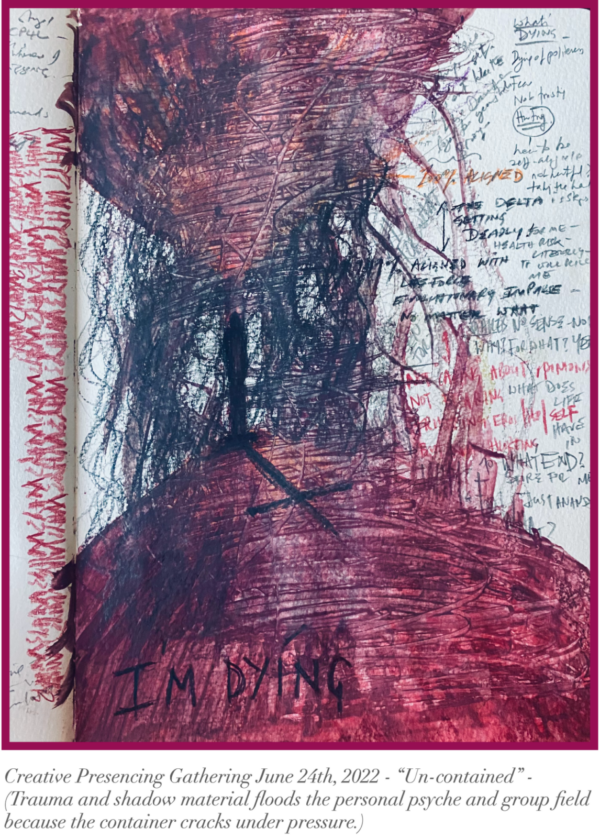
The gathering was called – people listening to an inner call and taking their agency to make it manifest and inviting the others in. Except for one person who had other commitments, all then-active practitioners came (!) and it seemed we were on a roll! It was beautiful, nice and inspiring to come together and hug each other after all these years relating online. But somehow – due to interpersonal dynamics that weren’t addressed – there were also some cracks in the relational field. It invited – or forced? – us to, step-by-step, untangle these emotional knots. It took a while, till the next spring, until all dynamics were revealed and shared in all transparency.
There are two big learning points we take away from this: When something isn’t aligned – for whatever reason – stop and go slower. The other one being: any community needs some kind of conflict resolution, what we call repair work. In the digestion process and looking back there was a realization that we should have stopped and maybe canceled the whole gathering. But it seemed the momentum was high and we didn’t. Every hosting team member learned some really important lessons; so after all it was more than worthwhile. This was huge, deep emotional work and showed us the importance of having some form of Rupture-Repair practice as part of a life-affirming working culture. (see more on this in Part 6)
From hindsight we can say that the phase of “aren’t we great together?!” was over and some real community was formed. Some people left the core group, the planetary meeting structure stopped, and open sessions kept on going. New practitioners joined and the community had to find its new rhythm and form. More and more senior practitioners stepped forward – taking their agency – to offer specific deep-dive inquiry series (4, 6 or 8 weeks, with a closed group). We see here the authentic gifts of these practitioners coming forward into the open, either testing the boundaries of the current practice, giving more attention to a certain aspect or applying it to a specific theme or question.
They seek out their own co-hosts and form their little hosting teams where many lessons are learned about how to be in co-creation: from wanting it too badly and thus learning about natural rhythm, from being too egalitarian and thus learning that calling some new experiment is asking for a safe environment to be able to hold it well, from seeing an opportunity and wishing something would happen to learning that becoming a field of hosting needs serious time of preparation, not the least processing your personal hope; from seeing yourself as a follower to then learning that speaking out your own wisdom feels actually quite good.
When the platform of The Stoa shifted direction (June 2023) that was for me another sign, another wobble, that our form and outward manifestation was asking for a change. It was easy enough to shift the Zoom account, and use our own newsletter more to inform people, but what is exactly our next growing edge? We are not interested in making Collective Presencing into a brand, but what is evolution asking of us, as a community?
I have told you how guiding questions are constantly leading us; they are at the heart of the dialogue practice. They help us navigate our journey. As Martin Shaw said: What if we reframed “living with uncertainty” into “navigating mystery?”