

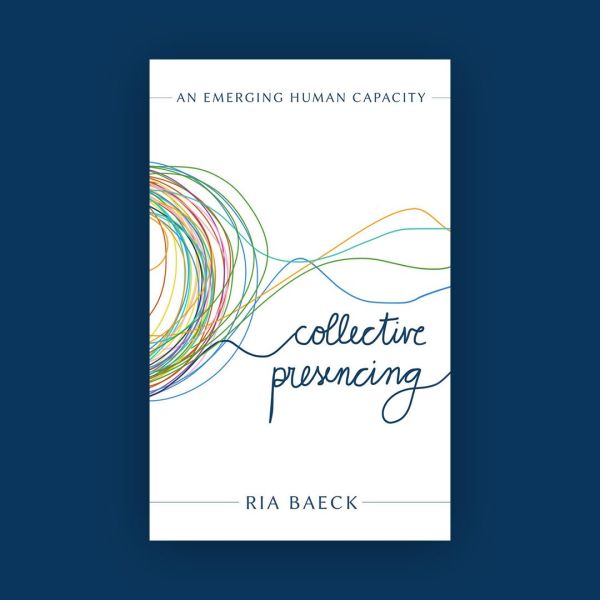
The Book
A story of a group of women intrigued about what else was possible if they were fully present with body, heart and mind and then engaged in an inquiry that was complex and inspiring. A story that unfolded over the span of six years and 13 gatherings. Of course, it grew out of other stories, of a Flemish circle practice group and a study in the Evolution of Consciousness. Over the span of this action research project, it touched many of its participants in many different ways, always pointing to living more of their potential.
This book maps out a journey that a group or a team can go through.
We started with a hunger to understand ‘the magic in the middle’ we experienced in some dialogue circles. Building on the ancient circle practice – as we knew it from the Art of Hosting – we explored, reflected, and explored further. What exactly makes the difference between empathic and generative listening – and an empathic conversation and a generative dialogue – as we noticed in Theory U material? Could we learn something of the age-old Quaker practice – to only speak when spoken through? How to be in a process where all involved are peers, and no one has official authority over the others? It turned out to be a journey with two distinct phases – and possibilities – where in the first phase we learn to be present, fully embodied in ourselves and open to the others, and what is going on in the group. In the second phase, we build on these capacities gained to expand our awareness to the wider context of soul, time, and space.
This book points to a collective potential that is hardly tapped in our current society
We hear the need expressed for some new collective sense-making and meaning-making. Our old maps and practices are no longer fit for the complex issues we see ourselves confronted with. We need non-rivalrous, collective coherence that will bring forth the best collective wisdom; nothing less will do the trick. The practice of collective presencing will build our inner muscles to feel and understand when we are actually in coherence (which is different from a new-age kind of harmony), uncover the assumptions that block us from seeing novel solutions, and invite us to reconnect, on a deep level, with nature, place, time, and the more subtle world. It challenges our fragmented worldview and will bring us to conversations and actions where we are in flow – because we want it, desire it, and need it.
This book is Ria Baeck‘s personal harvest of an action research project
Although no step was taken – and will be taken – without the deep involvement of many different people. Our hope is that this body of work – this collective practice – will help your group/team to live out more of its inherent potential. There is always more to uncover, and we are in great need of more of what is possible!
Download & Give What Feels Right
Our offer – We are delighted to share this e-book on: What becomes possible when we are truly present together? available online, without a pay wall.
Our effort – Thousands of hours were given to figure out the underlying principles and articulate them in this book. Everyone involved in this process believed it would make a difference in the world, and now we joyfully offer the product of that work as a gift to the commons.
Your contribution – As we offer, we invite donations to support and nurture this work — and its unfolding into the wider world — into the future. You can download this ebook or pdf for free (see below), but we are grateful for any contribution you are able to make, however small. Here is the proposal, maybe an experiment for you: we give you the files, and you give back whatever feels right for you, even when that is €0, £0 or $0!
Ready to give? donate here
Download Form
What others say about this book
Bonnitta Roy — Academic Director, The Divinity School. Founder, Alderlore Insight Center, Founder C-Labs, Associate of Perspectiva, Editor at Integral Review, Resident Instructor at The Graduate Institute
“People all over the world are recognizing the need for creating resilient communities and for building capacities for collective sensemaking. While, most people working in the field of collective practice focus on one or the other as separate domains, Ria has identified them as locations along a spectrum of skills that people can cultivate by participating in group process. Communities are built from deeper, more intimate practices of embodied dialogue that Ria calls “circles of presence.” This is a transformational process which, over time, creates the experience of co-presencing and emergent possibility. This leads to the second phase which Ria calls “circle of creation” where the group becomes capable of generating insights that can disrupt collectively held unconscious habits of thought, and lead to new possibilities for action. Participatory action, in turn, establishes powerful “virtuous cycles of learning” through which enduring new paradigms arise. You can read a host of other books on we-space and circling practices, but there you will be locked into a single domain that is blind to the other possibilities. In this book, Ria has succeeded, both intellectually and through the wisdom of practical experience, in connecting the parts into a greater whole, which is the standard by which all the other styles should be evaluated.”
Julie Arts — senior faculty member and consultant, Presencing Institute:
“Collective Presencing offers a practice and a framework, that is very much needed at this moment in time. We are becoming more and more aware that fundamental change doesn’t happen overnight, top-down or rationally. The practice of collective presencing takes the idea of Participatory processes to a whole new level of depth. Ria’s book offers a lot of clarity about the path of ‘letting go’ and ‘letting come’, crucial in the process of innovation and change. It deepened my personal practice, for myself as a human being (self-awareness); and it helped my work as a facilitator: to be able to invite others into that journey more confidently. But for me, the most unique gift of this book is ‘language’. Ria was able to give words to concepts that are intangible and/or that are so often used in the world of social change without having a shared understanding of what they really mean. I often went back to one of the chapters to find and share one of these descriptions. The book unpacks the many different processes and skills needed in this change process in such a way that I became more aware about what Presencing really means.”
Samantha Slade — Co-founder and steward of Percolab (international network of self-governed businesses) and author of Going Horizontal: Creating a Non-Hierarchical Organization, One Practice at a Time:
“Anthropologically speaking, we humans know perfectly well how to work, live, and play in and with emergence. We engage in emergence in different informal spaces, but mostly without noticing. It’s in our nature, and yet, we undervalue emergence. When we speak of breaking through to new paradigms and the socio-ecological transition, the keystone is working in emergence together, and tapping into the potential that abounds. Collective Presencing, is a critical piece of writing that helps us begin to really see this realm of the subtle that the human species carries as a gift. Collective Presencing helps us hone our emergent capacity and bring it forth. If you work in co-creation and emergence, or aspire to, then this book is for you. It helps you see what you might already be doing well and amplify it. It helps you have a view on the field that is so elusive to name. It helps the intangible feel more tangible, at least for a moment. Ria Baeck invites us into her treasure trove of discoveries, built from a lifetime as a research practitioner.”